
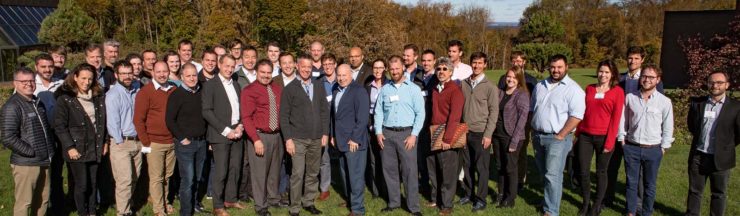

In mid-November, forty of the brightest minds in solar gathered just outside New York City. Their goal was simple yet audacious: find a way to dramatically reduce the cost of solar installations by re-inventing how they are designed and built.
The cheaper we can make solar, the faster we accelerate the shift towards clean energy. One of the fastest ways to adopt low-cost solar is to build it within the communities that consume the electricity. This is what I call “local energy” and it’s what the Freeing Energy Project was founded to do (see my TED talk).
The price of solar installations has dropped 2.5 times over the last seven years. This amazing group of executives, strategists, government leaders, and engineers came together to brainstorm how that cost can be driven down even further – as far as 2-times and even 3-times cheaper.
[elementor-template id=”16141″]
The event was convened by the widely respected energy and sustainability “think-do” tank, Rocky Mountain Institute. RMI is headquartered in Basalt, Colorado and has offices across the world. This “whole systems workshop” was part of RMI’s SHINE program which focuses on streamlining, improving and lowering the cost of what they call community-scale solar installations (read the post on community solar and how it has the potential to drive ultra-low-cost solar: Can community-scale solar become the Model T of clean energy?).
50 cents a watt by 2020
The November meeting was called 50×20, or “fifty by twenty” – this was shorthand for a vision that community-scale solar could hit 50 cents per installed watt by 2020. To make sense of just how audacious this goal is, let’s look at the numbers…
When most people think of solar, they just think about the solar cells or the solar panels. But the solar cells are only a part of a solar installation. Other parts include:
- Hardware – this includes inverters, the hardware that converts direct current from solar panels into alternating current for your house and the grid. It also includes racks, bolts, pilings and other things mostly made of steel.
- Labor – taking panels and hardware off of a truck then assembling and connecting them.
- Soft costs – land, financing costs, marketing (to find customers), fees to connect to the grid, contracts, procurement costs, etc.

According to a recent National Renewable Energy Laboratory (NREL) report, the cost of community-scale solar installations has dropped by an impressive 65% over the last seven years. Ironically, as the price of solar panels has dropped even more quickly (85% over the last seven years), the costs of hardware, labor, and soft costs have actually become proportionately larger.
This is precisely where RMI is focused. They came to the event with some impressive research and big ideas that promise to dramatically lower the cost of engineering, labor, and soft costs. The group spent 3 days building on RMI’s ideas with approaches like:
- Pre-assembling major elements of a solar farm in a factory – similar to the way pre-manufactured homes work, much of the installation can be done indoors, on an assembly line by highly trained workers. This dramatically simplifies and speeds up on-sight assembly. Errors are reduced. Less expertise is required.
- Standardizing contracts – because each installation is unique, most contracts are unique as well. The opportunity to streamline the financing, procurement, RFP, and grid connection contracts can greatly reduce the soft costs – which are now the most expensive part of a solar installation.
- Designing a better system – RMI’s specialty is “integrative design” – thinking about the entire system, not just the individual components. A good example of this is the Japanese manufacturing concept called poka-yoke which roughly means, “it only goes together one way.” The solar industry is in its infancy and the opportunities to design better systems are endless.
Is 50 cents per watt really possible?
Most of us arrived in New York fairly skeptical. But after three days of spreadsheets, whiteboards, Post-It notes, coffee and late-night discussions at the bar, the potential of continuing to drive down costs became clearer and clearer.
I won’t speak for anyone else but I think 50 cents per watt is inevitable – it’s only a question of whether it can be achieved in 2 years or 20. RMI and their assembled industry leaders have all committed to continue pushing the 50×20 idea forward. Regardless of how quickly we get to ultra-low-cost-solar, every step towards it achieves the most important mission of all… the cheaper we can make solar, the faster we can accelerate the shift towards a world powered by clean energy.
Big thanks to RMI’s iconic founder, Amory Lovins, as well as Stephen Doig, Joseph Goodman, Thomas Blank, Kareem Dabbagh and the rest of the SHINE team for convening this amazing event and for inviting me to be a part of it.


Leave a Reply