

When will my robot fold my laundry?
That’s the question I opened with when I recently gave the keynote at the RoboGeorgia Summit, in front of a room full of people who build these machines for a living. I spent two months digging for the answer.
The short answer is no time soon. Not even close.
Here are the slides (download button at the bottom):
Hypepotamus also covered the summit and this keynote: Georgia’s bet on physical AI and robotics, by Maija Ehlinger. Header photo courtesy of Hypepotamus.
Here are the three things I argued, with a little more detail on each.
Robotics has hit a new inflection point but the gaps are real
Decades of progress in batteries, motors, and software have set the stage for “physical AI.” But the biggest bottlenecks aren’t compute… they’re judgment and dexterity.
The AI came from large language models. Battery density came from smartphones and EVs. Motors and actuators rode down a cost curve built by drones and scooters. Cameras and lidar were paid for by phones and self-driving cars. None of it was built for robotics. Robotics gets all of it for free, and it still isn’t enough.
A robot is only as good as its slowest part, so I graded the parts. Sensors get an A. Perception gets an A, and that’s the AI we actually nailed. Muscles get a B+. Judgment gets a D. Hands get a D. Three are having a spectacular decade, two are failing, and here’s what surprised me… both failures are software, not silicon.
Judgment is knowing what to do when the world doesn’t match the training data. Automation cleans every square inch of the floor; judgment knows which inch to skip… just ask the robot vacuum that met a dog’s little accident. The reason it lags is data. There are roughly a billion hours of internet video behind today’s AI models, and about 300,000 hours of robot manipulation data ever collected, by anyone, in the entire history of the field.
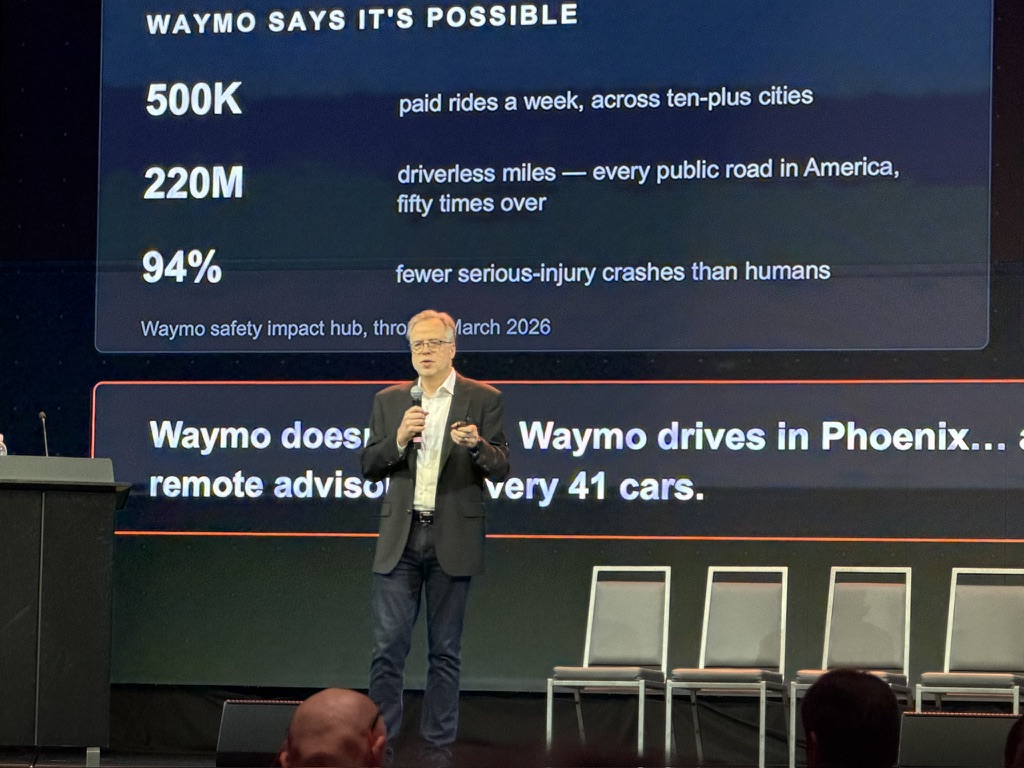
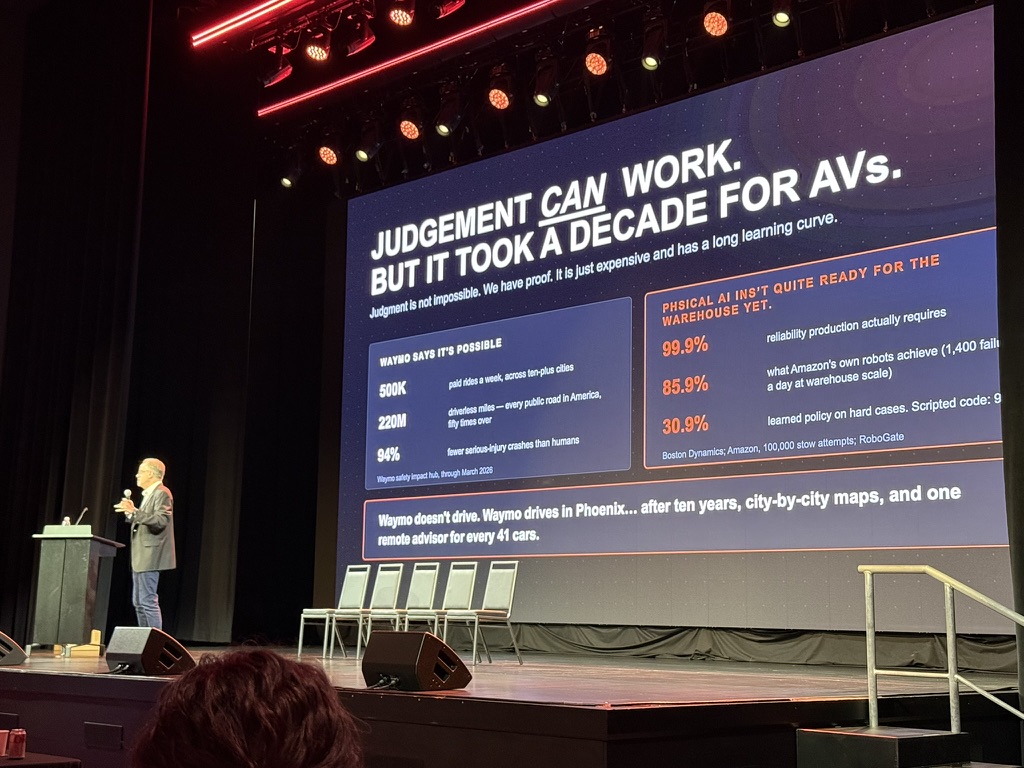
Let me give the optimists their due, because judgment clearly isn’t impossible. Waymo runs 500,000 paid rides a week with 94% fewer serious-injury crashes than human drivers. That’s proof. It’s also a warning about the price: Waymo doesn’t drive, Waymo drives in Phoenix… after ten years, city-by-city maps, and one remote advisor for every 41 cars.
Dexterity is the harder D. Your hand has about 17,000 mechanoreceptors and grips an object you’ve never touched 10 to 40% firmer than its slip threshold, automatically. We’re only now learning touch. Which is exactly why nobody is folding your laundry.
The humanoid hype deserves some skepticism
25% of venture is flowing into a handful of humanoid companies, but reliability tells a different story. On the genuinely hard cases, hand-scripted code still succeeds about 94% of the time, where a learned policy manages roughly 31%.
The real opportunity is deployment in real-world facilities, keeping in mind that the iteration cycle for hardware is quarters, not hours.
Those numbers matter because production is unforgiving. A working warehouse needs about 99.9% reliability. Amazon’s own robots achieve 85.9%, which at their scale is roughly 1,400 failures a day.
Humanoids dominate the feeds with dancing, flipping, and boxing… and the money followed them there. Funding into humanoid startups went from $1.5 billion in 2024 to $6.1 billion in 2025, with another $5.0 billion in just the first half of 2026, nearly all of it to a few names.
About those videos: most are curated. You’re watching take #47, because nobody posts takes 1 through 46. And a lot of the demos racking up millions of views aren’t autonomous at all… they’re a person in a motion-capture rig.
Meanwhile the two things everyone is racing to build are becoming commodities. China industrialized the robot body, and physical AI is going open source and open weight. That pushes the durable value to deployment data, integration, and trust… which favors whoever is actually out in the field, not whoever has the best demo reel.
To be fair to the humanoid believers, the biggest bet in America isn’t a fantasy and it’s 90 minutes down I-16. Hyundai plans more than 25,000 Boston Dynamics Atlas robots across its US plants, and Georgia goes first with the Metaplant in 2028. But look at the actual work: repetitive tasks, fixed routes, in a plant designed around the machine. Even that is really a bet on applied autonomy. They just made theirs look like us.
Georgia is one of the best places in the world to build in robotics (yes!)
Between AMPF, Georgia Tech’s research, and the third highest concentration of Fortune 500 headquarters in the US, Georgia has a rare advantage: multi-industry density across airports, farms, hospitals, logistics and more. More real-world testing environments than almost anywhere else!
Start with AMPF. There’s a self-driving robotics laboratory on 14th Street, where robots run the machines and AI agents design the experiments. Georgia Tech’s Advanced Manufacturing Pilot Facility just won $18.1 million from NSF to become one of twenty national AI cloud labs, and it quietly cut its rates for startups. If you wrote AMPF off as unaffordable, that was true and it isn’t anymore.
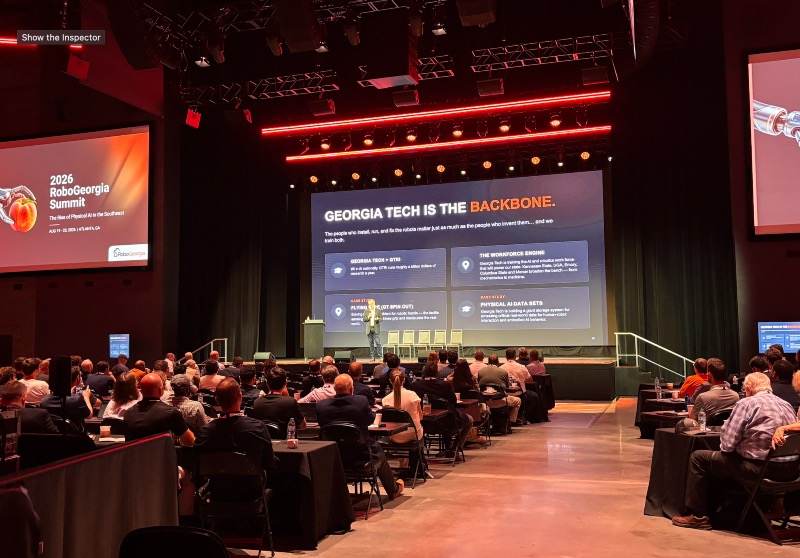
Behind it sits the research engine. Georgia Tech is #5 in AI nationally, GTRI runs about a billion dollars of research a year, and the state trains both halves of this workforce: the people who invent the robots and the people who install, run, and fix them.
Then the density, which I think is our most underrated asset. Georgia isn’t the biggest deployment market in the country… it’s the most diverse one: ports, docks, an airport, farm fields, hospitals, and plants. Texas has energy and logistics. The Inland Empire has warehousing at enormous scale. Nobody else has all six, owned by companies that don’t compete with each other. A robot proven at Home Depot can walk straight into UPS, then Delta, with no channel conflict.
And that variety is worth more than volume. Robots generalize based on the number of distinct real places they’ve worked. In one study, a model trained across 104 different locations matched a model trained inside the test site itself, without ever having seen it. If the bottleneck were algorithms, Georgia would have to catch up with Silicon Valley. But it isn’t algorithms… it’s machine-hours, in real places, doing real work. You can only virtualize a loading dock to a small degree.
Our companies aren’t waiting, either. Delta’s autonomous jet bridges have docked more than 1,100 flights with zero damage and zero injuries, a first in commercial aviation. And Slip Robotics, where my firm Tech Square Ventures was the first investor, makes the whole case in one product: they built a sled, not a humanoid. Every competitor tried to solve unloading from inside the trailer; Slip moved the problem to the dock and can load or unload a full trailer in about five minutes with no retrofit. Nobody buys a robot, by the way… they buy a payback period, and under eighteen months gets their attention.
One more thing changed the math three weeks before this talk. The FCC restricted imports of new humanoid and quadruped robots. Read the fine print and it’s not a ban, it’s a domestic-content test: 65% today, rising to 75% by 2029. A content rule is a manufacturing argument, and that’s a conversation Georgia can actually win.
So, when will my robot fold my laundry?
Not soon. The hardest problem between you and that robot isn’t a smarter model. It’s manufacturing, deployment, and enough different real places to train physical AI in the actual world instead of a simulation of it.
Which means the thing holding robotics back is the thing Georgia already has. Go Georgia! Go Southeast!
From the stage
Sources
- Maija Ehlinger, Hypepotamus, August 21, 2026. Coverage of the summit and this keynote.
- Bessemer Venture Partners, State of Robotics. Internet video hours versus robot manipulation data.
- Waymo safety impact hub, through March 2026. Rides and the 94% crash reduction.
- Boston Dynamics; Amazon (100,000 stow attempts); RoboGate. Robot reliability in production.
- Crunchbase (June 2026) and PitchBook (May 2026). Humanoid VC funding.
- US Bureau of Labor Statistics (June 2026) and the National Science Foundation (August 2026). Georgia manufacturing and the AMPF award.
Full transcript
Everything above is the short version. If you want the whole thing, the complete transcript of the talk is below, including the questions from the audience at the end, which were some of the best moments of the morning.
Read the full transcript of the keynote and the audience Q&A
Transcribed from the room recording at Trilith Live, August 20, 2026. The keynote runs about 36 minutes, followed by audience questions. Lightly edited for readability, with clarifications in [brackets]. Names and figures were checked against the slides.
Jump to a section
- Introduction
- Why Robots?
- Robotics Inherited Every Tech Curve
- The Scorecard
- Physical AI Is Just Starting
- Automation vs. Judgment
- Judgment Can Work: Ask Waymo
- We Are Just Now Learning Touch
- If You Believe the Headlines
- Where the Real Moat Is
- Robotics in Georgia
- Invent. Manufacture. Deploy.
- Georgia Tech Is the Backbone
- We Make Stuff Here
- The Customers Are Already Here
- The Biggest Humanoid Bet in America
- You Can Only Virtualize a Loading Dock So Far
- What Makes a Robotics Startup Fundable?
- The Three Vultures
- A Robot Startup That Made a Sled
- So, When Will My Robot Fold My Laundry?
- Questions From the Audience
- Will robots ever be plug-and-play, and will they sell to consumers?
- Are robots sold with a maintenance package, or as robot-as-a-service?
- What are you seeing in robot repair and maintenance?
Introduction
[00:00] So Bill is very well known in the tech ecosystem around Atlanta. He’s been the CEO of multiple companies. He’s a partner at Tech Square Ventures. He’s had three successful exits, including an IPO, which was huge. He’s also held roles at the venture firm Greylock, and at IBM as the company’s VP of corporate strategy. He’s kind of a technology geek. He’s got a double-E from North Carolina State. Always been into robotics.
[00:34] We thought of nobody better than Bill to come in and really kick this off with physical AI. There’s so much going on in that area. We’re trying to bring kind of ground… you know, get everybody grounded in what physical AI really means, where it is these days. And I think Bill will do a great job exploring that. So Bill, thank you so much. Welcome, Bill.
Why Robots?
[01:00] I was in fifth grade, and my parents took me to the greatest of all vacations: Disney World. And what I saw at Disney World changed my life, defined my passions, and set the course of my professional career.
[01:28] I walked into the Tiki Tiki Room. Anyone been in the Tiki Tiki Room, with all the singing birds? So for some reason, it absolutely mesmerized me. And then I went to the Hall of Presidents, and I decided that robots were the coolest thing I’d ever seen in my entire life, and that’s what I wanted to do.
[01:45] And, you know, why robots? What makes robots unique? Because it’s the intersection of every major kind of technology. So it’s not just software, and it’s not just hardware, and it’s not just electronics. It’s a combination, which unleashes incredible creativity. And you see that out here in the lobby. You’re going to hear about it all day today. And you look across the world, and the creativity that it takes… it’s almost an artistry to bring all of these technologies together into incredibly novel, groundbreaking entertainment, and particularly business applications.
[02:16] So I’m going to give you my take on robotics in 2026. And we’re going to poke fun a little bit at the humanoid noise, because I think there’s a little more smoke than fire there. And we’ll talk… okay, so I’ve already got an applause on that one. And I’ll show you some of the perspectives that I have on it.
Robotics Inherited Every Tech Curve
[02:39] So the cool thing about robotics, and if you’re a student of tech history, certain industries have really catapulted because they have built on the backs of other industries accomplishing different projects, accomplishing different goals. But the net of it is that they are able to accelerate their development tremendously because of the work done by others previously. They say, if I’ve seen further, as Newton said, if I’ve seen further, it’s because I’ve stood on the shoulders of giants.
[03:07] Robotics has benefited from every imaginable kind of technology, from batteries and AI to motors and, of course, software. And all this has come together to mean that robots have had an accelerated development curve, because these things didn’t have to be developed from scratch. It just picked and borrowed. But we’ve kind of reached this nexus called physical AI, where it’s harder to see through what that means, what the limitations are, and where it takes us. Hopefully I’ll poke a little bit at that question today.
The Scorecard
[03:41] So I’m going to give a quick scorecard to the five areas that I get excited about for AI. Obviously, for electronics and software, general systems like that, we’re doing really well. Motors are getting really cool. As I was putting this together, I really enjoyed reading about just how quickly motors are developing… actuators, feedback systems that allow these things to respond in a human-like way.
[04:10] But where we really fall short is judgment, and that’s a little bit about what physical AI is, and we fall short in the hands. And those two together are going to be the two biggest reasons for us to have the robot fold your laundry.
Physical AI Is Just Starting
[04:25] So, again, building on the idea that robots have come from a lot of existing work, right? There’s a billion hours of video on YouTube. A billion hours. So that’s what’s been training these AIs when we go and ask questions, or we’re thinking about writing a speech and we say, “Hey, what should I say about this slide?” A billion hours of YouTube videos and countless sources come together, give me a chatbot that gives me intelligent answers. A lot of the answers you gave me were wrong, so we had to go back and check it. But it was a fascinating source to start.
[04:55] It’s not really easy to think that with an AI as smart as ChatGPT, or Claude, that you can just carry that over to a robot. But it turns out not to be the case at all. One study found that the total sum of all the publicly available robotic information about movements and physical actions of robots was only about 300,000 hours. I’m sure in private labs it’s many times, ten times, a hundred times, that. Generally speaking, it lags by decades. Data isn’t a singular domain like speech or writing. So it’s really at the very beginning, what it takes to create the data sets that are necessary to create similar outcomes that LLMs are giving us.
Automation vs. Judgment
[05:39] And here’s the difference. Knowledge tells us all you have to do is watch your robot Roomba go over a dog’s little accident, right? As soon as you see that, you know the difference between automation and intelligence. Automation says, let’s get every square inch. Intelligence says, not that square inch… not those five square inches.
[05:58] And, you know, it’s kind of a silly example, but the difference between what lives in the theoretical world, words and twins and things like that, versus what happens in the physical, actual world, are so profoundly different. That’s where the opportunities, I think, as an investor, are going to be most exciting. Every chicken is different. Every weed is different.
Judgment Can Work: Ask Waymo
[06:24] Now, the good news is that judgment is actually possible. Anybody here taken a drive in a Waymo? Like, you’ve got to get your head around how crazy that is. And you’re in traffic, and there’s a Waymo next to you, and I go back and forth between being completely amazed that this isn’t going to kill me. And then when I ride in it… my colleagues didn’t get to be able to get a Waymo to come to my request at Uber. So my colleagues made a game of it. We all called Uber, and finally a Waymo came and picked me up. I had been in the first Waymos back at a TED conference like 25 years ago. Being in a modern Waymo in Midtown… absolutely amazing.
[06:59] And it showed two things. First of all, that you can take these AIs and use them way more than an LLM was likely ever… and you can take it to levels that are nearly inconceivable when you understand the underlying technologies. But it also makes you realize that they can’t take what they learned about driving Waymos in Midtown and Buckhead and take that to Charlotte and Tampa. Every time you build an engine smart enough to do something that automated, that has that much judgment, you need to go and train in every venue. And this is a core area of value creation we’re going to talk about.
[07:38] If you think about it, most of the systems that run, most of the robots that run in these facilities today, are 99% reliable, right? Even the automation systems from Amazon, powerful and as iconic as they are, are below 90%. When you try to apply learning heuristic systems, one study found, to physical AI, you only get about 30% correctly. Whereas if you program it predictably, then you can actually get above 90%.
[08:11] So there’s still this gap between the mystery of how an LLM gives us such great answers and the reality of putting that into work to drive robots. And, of course, if an LLM gets the answer wrong… unless he’s up here giving a speech, and the number is 85.2, not 85.9, oh my gosh, we’re going to survive that one. But if the robot gets the AI wrong, it’s going to run into something, break something, or even worse, it’s going to break somebody. So there’s a gap that doesn’t get enough attention with all the videos we watch, which is also safety.
We Are Just Now Learning Touch
[08:44] The other gap where we fall short is hands. In the human hand: 17,000 nerves, and many times that in the receptors in your hand. One study to demonstrate how powerful those receptors are is that it senses when something is slipping, and it can change dynamically how tightly I hold on to this versus how tightly I hold on to this. And that ability, that acuity, is, for the most part, unmatched… certainly unmatched at any scale.
[09:19] So in something like laundry, with the soft fabric, with the soft dynamic thing to touch, it’s probably one of the last areas that you’re going to see work well. Good news… it’s not only [being worked on], it’s being worked on here in Georgia. We’ll get to it.
If You Believe the Headlines
[09:38] Read the headlines, and if you’re a robot nerd, as I am, and you get feeds on Instagram with robot nerd stuff, you see things that are really cool, right? You see these videos, all these cool robots doing really cool things.
[09:55] And the question is… you know, the challenge is that these videos are so exciting that it’s draining the money from venture capital. Fully one quarter of the venture capital money flowing into robots, fortunately it’s only a quarter, is going into a handful of U.S. and Chinese-based gigantic robots. I’m sorry… humanoid giants.
[10:18] So there’s an increasing amount of money going into those types of robots, because if you can make a humanoid robot, it’ll fold your laundry, it’ll walk your dog, it’ll mow your grass… and it costs me $25,000, less than a nice car, and all my housework can get done. And I have people who are very smart, who have invested hundreds of millions of dollars, look me in the eye and say, “This is shipping in 2027.” It remains shipping. But if, in fact, I can get a robot that can fold my laundry and mow my grass in 2027, I will sell my car to buy it.
[10:56] But the reality is that these videos are all a little contrived. A lot of them have a human operator. I love this video, because it kind of shows… you notice the robot also falls over when its operator gets kicked. And, you know, when you watch some of these videos, Atlas videos, you watch them take 47, and you’re not seeing the takes one through 46. This was a good example that made the news, because this was take one. And that poor guy… best part was the robot copying him as it fell over, grabbing his stomach.
Where the Real Moat Is
[11:33] And so my thesis, as an investor, and for all of you, and I want you to challenge this, I’ll be here, I think there’s real money to be made in AI and software and robot bodies. But I think that’s not where the biggest value is going to be created. There’s not a lot of moat in making robot joints, or even making robot human beings… at least so far, because there’s so many people going after them in the U.S. and China.
[11:58] I think the real moat is when you actually stick a robot, whether it’s a humanoid or something on four wheels, you stick it in a real-world facility, and its ability to actually get the job done safely, at scale, with an incredibly high ROI. That, to me, is one of the biggest opportunities. It’s really boring stuff. That’s going to probably make most of us, as robotics professionals, as robotics investors, as startups… probably the most lucrative areas. Something that’s difficult to talk about at a cocktail party, but survivable, and maybe incredibly exciting as a business.
Robotics in Georgia
[12:35] So where does this come in for the state you live in? I am all in on Georgia. We have one of the most remarkable and underrated places in the world, in the country. When I was putting this together, I was doing a lot of research on just where Georgia stands in trajectory for robot success. And I’ve got to tell you, and I’ll share with you, I came out a lot more excited and a lot more optimistic than I expected to.
[13:01] So… anyone follow this? The FCC’s announcement three weeks ago. This is nuts. Okay, not everybody. So the FCC declared three weeks ago that all Chinese humanoid robots and all Chinese quadrupeds, new ones, are not allowed to be shipped in the United States. Full stop. You just can’t buy them. They won’t be able to make new models. They can continue to ship old models. I may have misunderstood it, but I looked at this. I read the report from the FCC. I read the articles on it.
[13:40] And so there’s a lot of companies, maybe several of you here, that are somewhat dependent on buying cheap Chinese robots as a basis for your businesses, and now they’re cut off. And, I mean, we can debate industrial and domestic and national security policy all day long, but from a practical matter to businesses, the fact that this was, I think, unexpected, or at least it wasn’t widely anticipated, and it’s now basically impossible to ship a new model of a quadruped in the United States.
[14:07] And you look at it, like a Boston Dynamics dog, Spot… and that’s going to be $25,000 to $75,000. And you get a Unitree version of the Spot for $3,000 or $4,000. Now, they’re not the same thing. They look the same, but they’re not the same robot. But regardless, that functionality has been accessible and created much better gross margins if you buy it from China than buying it from the U.S. And I don’t even know if the U.S. has the capacity to come anywhere close to filling, money aside, what we’ve been buying from China. So this feels like an earthquake that we haven’t even seen coming, and we’re starting, and no one knows what it means yet. I haven’t read much about this in the mainstream news, but it feels like it’s going to be there.
Invent. Manufacture. Deploy.
[14:49] So the really cool thing for us, maybe through this change from the FCC and other things, is that I think it puts Georgia in a really unique, exciting place to stand out and make a massive difference. The three parts of the robotics lifecycle: one is to invent it, the second is to manufacture it, third is to deploy it. These last two are what I get most excited about, where we live.
[15:16] So, down up on 14th Street… WABE called it the nation’s first university self-driving robot lab. Has anyone been to AMPF? So if y’all need to go… I mean, this is… I run an organization, I have an organization called Engage, which is a consortium of all large companies in Atlanta: Coca-Cola, UPS, Georgia Power, Georgia-Pacific, Home Depot. And all their CEOs are on our board. We took a bunch of the CEOs… Tim Lieuwen, who’s the EVP for Research at Georgia Tech, hosted us and gave us a tour of this place. And one of my favorite pictures was the CEO of a Fortune 500 company standing there looking at the robot that was bluntly waiting for him to get out of the way.
[15:54] But what AMPF does is amazing. It just raised over $18 million in grants to make it so that you, as a scientist anywhere in the world, testing a material or a device… it’s all early stages, but the robot will carry your device from one testing system, it’ll upload the results from those testing systems and drive over to another part of the factory. They have 160 machines. They want to get to, I think, 400 or 500. And this is one of the few places in the world, certainly one of the tiny [number] available publicly, and Georgia Tech’s doing an amazing job of making it successful.
[16:34] So they just, it’s not widely announced, they’ve lowered the prices to actually work in this facility. So if you have a startup that wants to test the next generation of manufacturing, either it’s a material science company or you’re testing robots and you need to make something at scale, this is one of the best places in the world. It’s right here on 14th Street.
Georgia Tech Is the Backbone
[16:54] You know, Georgia Tech, along with the other great universities in our backyard here, is the backbone of this entire story. Georgia Tech spends billions on research. GTRI, its cousin, spends a billion a year on research. It is the workforce engine for everything from AI programmers to roboticists. Take the consortium of Georgia-based universities… we are training one of the best workforces that exists in the country, right here, at scale. All kinds of jobs.
[17:28] And so, some great examples out of Georgia Tech. Flying Wire, I don’t know if I can show this here, but an amazing company, is solving the robotics touch problem. So they have a system developed out of Mike’s work as a professor at Georgia Tech. He’s involved with a system that embeds thousands of tiny little microprocessors and sensors in tape or in fabrics. And it can give a robot hand not quite the human hand density, but it has the ability to come anywhere close to the microscopic density of sensors that are necessary. And they can embed all kinds of sensors. They can embed heat sensors, proximity sensors, positive pressure sensors. And they can feed it into a mesh network that they build. It’s a really amazing technology born at Georgia Tech, spun out, funded… and you can watch that space very carefully.
[18:13] I just learned, it’s not been announced, but I was told I can talk about it today, Georgia Tech received $500,000 to build a massive data storage system on campus. One of the key uses of this is to gather physical AI raw data, put it in a single place, and allow researchers to have a single place to go to get massive amounts of data. It’s hard-to-find data, so they can start training a new generation of physical AI models.
[18:38] So, you know, Georgia Tech plays this amazing role. How many of you are actually working for Georgia Tech here? There’s probably three or four. They’re probably coming later when their speakers come. But anyway, I know there’s going to be three or four Georgia Tech folks here. And the work they’re doing is going to define the future of our state.
We Make Stuff Here
[18:56] We make stuff here, man. So this is where we manufacture it. I was really surprised. I’d heard of some of these companies, but the stories of these global giants that have come to our state to have their North American headquarters, massive facilities for manufacturing, some headquartered here… the list of manufacturing and deployment for robots here in Georgia is an incredible story that I have not seen talked about. So when someone thinks about, “I need to build robots, I need to deploy robots”… Georgia’s the place they’re coming. It’s an amazing list.
The Customers Are Already Here
[19:32] The other thing that we take for granted here… you know, Georgia has the third highest number of Fortune 500 companies in the nation. Third highest Fortune 500 companies in the nation. But there’s a superpower to that list that changes the trajectory of our state.
[19:54] I’m an energy-passionate guy. I’m a venture capitalist… that’s corporate enterprise technology. I’m a robot nerd. New York: all of the Fortune 500s, or most of them, are finance. So you can’t put them in a room other than trade groups, because they compete. Go down to Houston, where it’s number two… same thing, it’s all energy. So they’ll get in a room together, but they’re going to keep their cards close to their vests, because they don’t want to share their proprietary secrets.
[20:26] You stick the $10 billion-plus companies in Georgia, ones that aren’t here, like Cox and Georgia Power, you stick them in a room together, which is what we do for a living at Engage. And they have conversations like some of which they’ve never had in their professional lives. Because they can talk about, “Well, what are you doing with robotics? What is your strategy for dealing with the tariffs? What do you think about AI, and how are you using it culturally, and how are you messaging it to employees?” They can have these conversations with each other. We at Engage have this incredible privilege of helping host some of those conversations… hopefully a catalyst.
[21:04] But if you’re a robotics company in Georgia, you have a chance to put your technology across multiple industries. You can put it into a retail setting with Home Depot. You can put it into a full-on logistics setting with UPS. You can put it into an airline setting with Delta. One of the things Engage does is to make it a bit easier to get those opportunities. It’s still very hard, but there’s not any other place where it’s even possible.
[21:34] I think if this community here in the audience comes together, I’d like to really convince these companies and others, Norfolk Southern, and Novelis, and others that are making great, complicated things, that automation provides something they can perhaps come together [on], to be like Georgia Tech’s done: create a nexus for testing, learning, and deploying.
The Biggest Humanoid Bet in America
[21:56] And by the way, the biggest bet, Ward mentioned it, in humanoid robotics in the world, is just down the street. Crazy. So even though I’m skeptical of humanoid robotics in terms of their value creation, it’s really interesting to look at what Hyundai’s doing. They’re going to, they say, deploy 25,000 humanoid robots… a whole bunch of them in Georgia, first in Georgia.
[22:24] What’s interesting about it is that their thesis… I think there’s two things that it’s easy to miss. One is that thesis is they can put these humanoid robots in a place where humans can work, which has implications on labor and jobs, but I’ll put that aside for just a moment. Their thesis is you can update an existing factory and automate it with these robots, and you can move these robots between different types of jobs, and do so with fluidity… whereas traditional large-scale robotic automation, every robot has a specific job. It’s trained specifically and follows a very sequential order, which works really well. Most things in the world are made with robots that way. But this is a new model.
[23:10] But the other thing I think is really interesting about this is that they’re going to be training robots in these different jobs, and they’re going to be building that proprietary data at a scale for humanoids that no one’s done before. They’re putting it in the real world to capture the mounds of data that are going to come back. That’s going to be one of the most competitive data sets, I would imagine, in a robotics world… and good for them, as an end customer building that data.
You Can Only Virtualize a Loading Dock So Far
[23:35] See, the thing is that I can go do a 3D scan and create a digital twin of a loading dock. I can create a 3D scan in my house, tell the robot, to some degree of intelligence and flexibility. But am I ever going to get my robot vacuum not to run over the dog? Because it doesn’t even know what it is. It’s a dog, or it’s something else. So there’s a piece of trash or something that no one ever anticipated. They changed the way the door opens… no one thought about it.
[24:06] So you can only do so much training. You see these videos of massive physics simulations where they’re training humanoid robots how to fall over and get back up again. But those all assume a perfect situation, where gravity is uniform, the situation is a flat floor, or maybe climbing stairs… they’re all very predictable, relatively uniform settings. But if you get into the real world, you’re going to find this degree of autonomy becomes massively harder. The robot’s going to run into these situations… which is why the Hyundai experiment is so fun.
[24:41] So I think it’s less about the algorithms. I think it’s less about what’s the model, and a lot more about where do you get the data. Not just the data for how you make a robot walk, or how do you make a hand [grip] a piece of fabric, but the data. In this particular building, Trilith Studios, what are the things that the robot needs to [do]? So we can assist the staff here and set these chairs up automatically, or open a door in the morning, or whatever we have to do. What it needs to be [is] this space now.
[25:13] So… we need to make that easier and faster. That’s the moment I get excited about as an investor. It makes geography matter for the first time. And I believe that Georgia has the best geography in the world, because we have more industries in one place than any other place in the world, from what I can tell. We have ports. We have the world’s largest, busiest airport, one of the largest ports. We grow things, animals and plants, the largest farms. We have hospitals. We have every magical place where robots matter… we have it all here.
[25:50] So if you want to build a robot, if you want to train a robot, if you want to get that data that makes a robotic solution more competitive than everybody else’s… this is where you should be. Get in the car, maybe an autonomous self-driving car, and go test your robot in more settings than you can [anywhere else].
What Makes a Robotics Startup Fundable?
[26:11] So I want to wrap up with… as a venture capitalist, how do we think about robotics? And the secret of VC that you don’t hear often, but certainly for me the most fundamental thing: almost no company of any kind… software, robotics, any kind of business software, any kind of company you’ve ever seen that inspired me or received a lot of funding… never got it right the first time.
[26:41] So people [say] the reason VCs like software, it’s true, obviously a lot of the venture goes towards things outside of software, but the reason VCs like software is the speed at which you can iterate it. Really get your head around it. Because it turns out the first version of your software sucks. And no one likes it. Or it has a massive problem. So you just go to the engineers or the coders and you say, “Let’s fix it.” Within an hour, [you fix] the feature that’s causing you to lose sales. You have to fix the bug that was causing the customers to churn. Software you can iterate 20 times a day, a thousand times a day. So the term we use in VC is product-market fit. So you can get product-market fit in weeks if you’re good. Used to take a year or two… now you do it in weeks.
[27:37] Here’s the problem with anything hard-tech, robotics included. You put that robot into service. Maybe there’s software you can upload remotely, but maybe there’s a weakness in the joint. There’s a motor… you’ve sourced the gear, this particular gear, wrong; it’s made by a sub-tier manufacturer; you didn’t foresee it… and the right leg keeps failing. Iterate on that? It’s a million-dollar proposition, and you have customers who are absolutely furious because their robot isn’t working.
[28:05] So the challenge for a venture in any hard tech, robotics [in particular]: it takes the iteration time to learn and market it. Maybe it turns out that motors need to be a bit stronger in the shoulders so that you can lift your boxes in a way that is more fluid and fast, and you need to update your motors. So the problem, the challenge that we see, is that that iteration cycle for hard tech is not measured in minutes and hours… it’s measured in months and quarters. That’s [why VCs like software] quicker.
[28:40] The cool thing about robotics is that it’s [not] hard to get this excitement. The reason you watch all those humanoid robot videos is because it’s like, really neat. You can imagine, you see it, you’re inspired. It’s like watching a rocket launch or some kind of amazing technology… those of us who are engineers get excited about this stuff, love to watch it and see it over and over again.
[28:59] There are a set of people who are so brilliant, so motivated, and so strategic, they can go out and build a robot that does something that no robot’s ever done before. People look at it and they’re absolutely amazed. Doesn’t mean anybody wants to buy it. Doesn’t mean it actually solves a really big business problem. Maybe there’s a future version that will… the iterations and the cost to get them [there].
[29:29] So when you talk to a VC about funding your robot startup, keep these things in mind and understand: how much of it can you put in software? How can you reduce the on-site, deployed robot risk, updates and failures… and what is your plan if there is a failure? How are you going to go on site? Are you going to start in a small region? [Or] all over the country, the world? All of these are really important questions.
[29:54] When you talk about the robots that VCs really get excited [about], at least this VC gets excited about, it’s the ROI. What I’ll tell you is that people don’t buy a robot, they buy a payback period. They don’t buy a robot, they buy a payback period. So the robot is a means to an end. The great news is there’s an infinite number of ways where a robot can lower the cost, improve the quality, and speed the output of a multitude of products. That’s what people are buying. They’re not buying the robot’s features.
[30:25] When you make your proposition to the venture capital, structure it that way. I see so many hard-tech presentations where they don’t even start to think about the payback period. Even if it’s “we have to make a thousand of these before we get to [that point]”… that’s the answer that’s going to be required for a business to be successful selling any kind of hard tech.
The Three Vultures
[30:42] I joke that startups… when you do these startups, I’ve done startups my entire life, I’ve been turned down by more VCs than I can count. Raising venture capital, I’m sorry, doing a startup, is bad, but I think of it as a couple of vultures flying around a carcass. In front of you, your startup’s barely alive. They’re sitting there gasping for air. You see some vultures flying around… but in a good way.
[31:10] One of the vultures is venture capitalists. Those are the ones that everybody’s trying to get. Somehow, venture isn’t the answer. That’s what you see on Shark Tank, and that’s what we’ve heard about in tech circles. Venture’s often not the answer, especially in robotics, because there’s so [many] grants and other areas available to get money. But they look at the venture capitalists, and they get fixated on the venture capitalists, and they don’t want those other two… [which] are really great.
[31:31] Another vulture is an extremely senior person who has much better career alternatives, who’s going to come join your startup. That is a strong thing. When that vulture dives, VCs will follow much more quickly.
[31:43] But there’s no vulture that VCs will get more excited about… the first vulture is when you have a customer. Because VCs, at the end of the day, they’re never going to know [what’s] in the back of a robot that you do. You’re never, they’re going to, you’re asking them to make a million-dollar bet. But if you can have a couple customers take a $100,000 bet, that are experts, that are going to have people that know how to buy a robot, know how to deploy it, and vulture VCs see that customer put money down there to see you, then they’re really interested.
[32:10] So pilots are… and you know all this, but I think putting it in this context is how the VCs [see it]. If you have people that say, “I want to give this a try,” that’s great. If you have people that say, “I want to buy this when it’s finished,” that’s even better. To get a contract that says “we’re going to run a pilot”, even better yet, “we’re going to buy 100 of them as soon as they’re ready”, your problems almost always go away.
A Robot Startup That Made a Sled
[32:35] So I was going to end up telling you a little story about a VC-backed robotics company here in Georgia. Full disclosure: we were the first investors, at Tech Square Ventures, in Slip Robotics. I don’t know if anyone’s here from Slip, but what you guys have done is amazing. And I think this highlights what is missed about robotics.
[32:55] I watched their CCO last night in the panel, and he was almost apologizing for how simple the robot is. I wanted to stand up and say, “No, no, it’s brilliant.” The simplicity is, it’s brilliant. That is… it [drives] ROI because of the simplicity. It’s got a tiny handful of motors, standardized, off-the-shelf motors… not exotic manipulator motors with all this complicated tech inside of them that a humanoid does. So they can make these things at scale, they can source the parts from a variety of places, and it solves an incredibly common problem.
[33:31] If you’re talking to a VC, tell them that you can solve a problem that happens 100,000 times, 100,000 places, a million times a day… you’ve got my attention.
[33:42] So this company’s done an amazing job. They’re just one great example of a set of really exciting startups that are happening here in town. And I applaud all of you that are taking big swings to make a difference in robotics. Because this is, I think, as your company comes to maturity and you’re getting ready for pilots, this is maybe the best place to hire your team, because of all the robotics and manufacturing that’s here. It’s the best place to try your ideas, because of Georgia Tech and other universities here, in Kennesaw. And it’s the best… it is the best place to get funding, but we’re working on it.
[34:18] But if you have a great company, I promise you, funding from all over the planet Earth will find you. I want you to be down the street, but if you build an amazing company, you’re [set]. Slip Robotics, their recent funding came from the West Coast. There’s just [not any] VCs here that can do the scale of funding they require. We need to fix that, but in the meantime, the money will find companies.
So, When Will My Robot Fold My Laundry?
[34:41] So, to wrap it up: when will your robot fold your laundry? Don’t hold your breath. I think it’s at least three or four years away, more like five or ten. And I don’t think we’re going to see $25,000 humanoid robots, despite people who have invested hundreds of billions in them promising that that’s what they’re going to cost.
[35:03] I think that… there’s some statistics I found that the Optimus robot by Tesla: if they had to source it from U.S. domestic manufacturers, their cost would go up by 3x. So it’s a complicated and unsure supply chain that’s affecting this new generation of robots.
[35:23] I can tell you that as a VC, as a business person, the opportunity is to make a simple skateboard, drive in and out of trucks, and solve one of the most mundane problems on planet Earth. I love Slip, because everybody else is trying to build robots that walk in, pick a box up like a human… and they build these fancy Amazon things: suction comes on, and it goes in and moves the boxes, or pushes in a giant assembly line, it extends the conveyor into the truck so it’s going to load in the back of the truck.
[35:59] Slip says, “Think differently.” Literally think out of the box, and [load] the truck up before the truck [even gets] there. I think that’s what keeps me excited. And I think this is one of the best places on planet Earth to build companies like that. In the next 100, we’re going to redefine the box.
[36:14] So I appreciate you all coming out today. This is a great community. And I think I have a minute to take questions if you have some. Yeah. All right. So anyway, thanks a lot.
[36:22]… End of keynote.
Questions From the Audience
*Audience questions are reduced to a one-line bracketed summary, per request. Absolute timestamps continue from the keynote. The formal session closes at 44:03; the recording continues afterward with informal hallway conversation, not transcribed here.*
Will robots ever be plug-and-play, and will they sell to consumers?
[37:28] Selling to consumers is an incredibly seductive thing to do. When you meet venture capitalists, they usually self-define in one or two categories. The vast majority of them sell to businesses… B2B. So why is it that direct-to-consumer, and selling to end users, is harder?
[37:48] Somebody said that the great thing about the challenges on the consumer [side] is you’ve got people who have a lot of time to think about what they want to buy, and a lot of expectations, and not a lot of money. They love selling to businesses, because they’re usually not very smart and they have a lot of money.
[38:08] So business-to-business is a great target to start with for any kind of company, because you can make an ROI case, black and white. It doesn’t have to look cute. It doesn’t have to be marketed. It doesn’t have to be a Super Bowl ad. It’s a very straightforward value proposition, straight from creation to value. Consumers, distribution, user hotlines, all these things are incredibly complicated.
[38:31] So I have, I should have brought it today, I don’t think anyone here remembers when Sony shipped the first robot dog in the world. The AIBO. First one that was shipped to the United States; really proud of it, it’s on the shelf. And so this was an early experiment in direct-to-consumer robotics. They sold it. It was really good… it’s really amazing for 1997. But in the end, I think, unless you can do something where you can [go along] and do really useful things, I think most of the market’s going to be “I will buy one,” but most people will probably not buy one.
[39:05] So it’s also difficult for an investor to get excited about a consumer robot unless they have conviction that the scale is going to be extraordinary. It’s hard to see that, and there’s a lot of failures right now. [But] it takes just one. And I’ll remind everybody here old enough… some company came up with, in the ’80s, Pet Rocks. Took a rock, stuck it in a box, and they sold millions of them. So the great thing about consumers is if you do get the right idea, better than a Pet Rock. So it’s a bit of a roll of the dice.
Are robots sold with a maintenance package, or as robot-as-a-service?
[40:14] Robotics as a service, which is what Slip is doing, standing mostly… versus selling the robot as a unit. Software made a huge change 20 years ago, from being sold by the disk, CD-ROM, [or] by the download, to using it by the month. And I do think that buyers prefer to buy it by the month, by a large portion.
[40:46] But for a startup, it creates massive problems. You want to finance and own all those robots while you lease them out. Usually those robots are new, complicated, and it’s very, very difficult. They have to rely on VCs, and funding is prohibitively expensive.
[41:00] So I think that, in general, advanced robotics companies are probably going to sell the first dozen as units, or giveaways funded by their equity investors. They’re going to struggle to scale… finance 100, finance 1,000.
[41:23] So… Dennis Hayes. One of the greatest days [of my life], after I went to Disney World, was when I upgraded my Hayes modem from a 300-baud modem to a 1,200-baud modem. Absolutely huge day in my life. Changed my access to the world… and this was the great Georgia story. Thank you for asking a great question.
What are you seeing in robot repair and maintenance?
[42:11] Yes… repair and maintenance is a massive, venture-fundable opportunity in every business that has hardware parts of any kind, including robotics, when there’s enough robots in place. I guess there are industrial robots, but yes: repair and maintenance is a massive, venture-fundable opportunity, and every business has hardware parts of any kind, including robotics.
[42:29] We fund companies in my firm that have saved, I won’t name the companies, listed large enterprises, $100 million a year in spare parts: the inventory and deployment of those parts, specific to the industry in that case. Using AI and other capabilities, they were able to have higher rates of spare parts being available, [lower] costs, being automatically smarter and more likely to [have what they] need.
[42:56] So I don’t know of any case in robotics, but that would be a really exciting space… especially for just dumb old industrial robots, to solve that problem. I don’t know if the space will end up [big enough], but [it’s] exactly the kind of problem venture capitalists love.
[43:12] My thesis is that you can tell it’s a really good venture capital bet if you go to a cocktail party and no one wants to hear about it. And so if you have a humanoid robot folding laundry and everyone wants to hear about it, it’s probably [not] the [best bet].
[43:37] Thank you very much. It’s a real honor to be here today.
[44:03]… End of formal session (closing remarks and the RoboGeorgia hat presentation).
Leave a Reply