
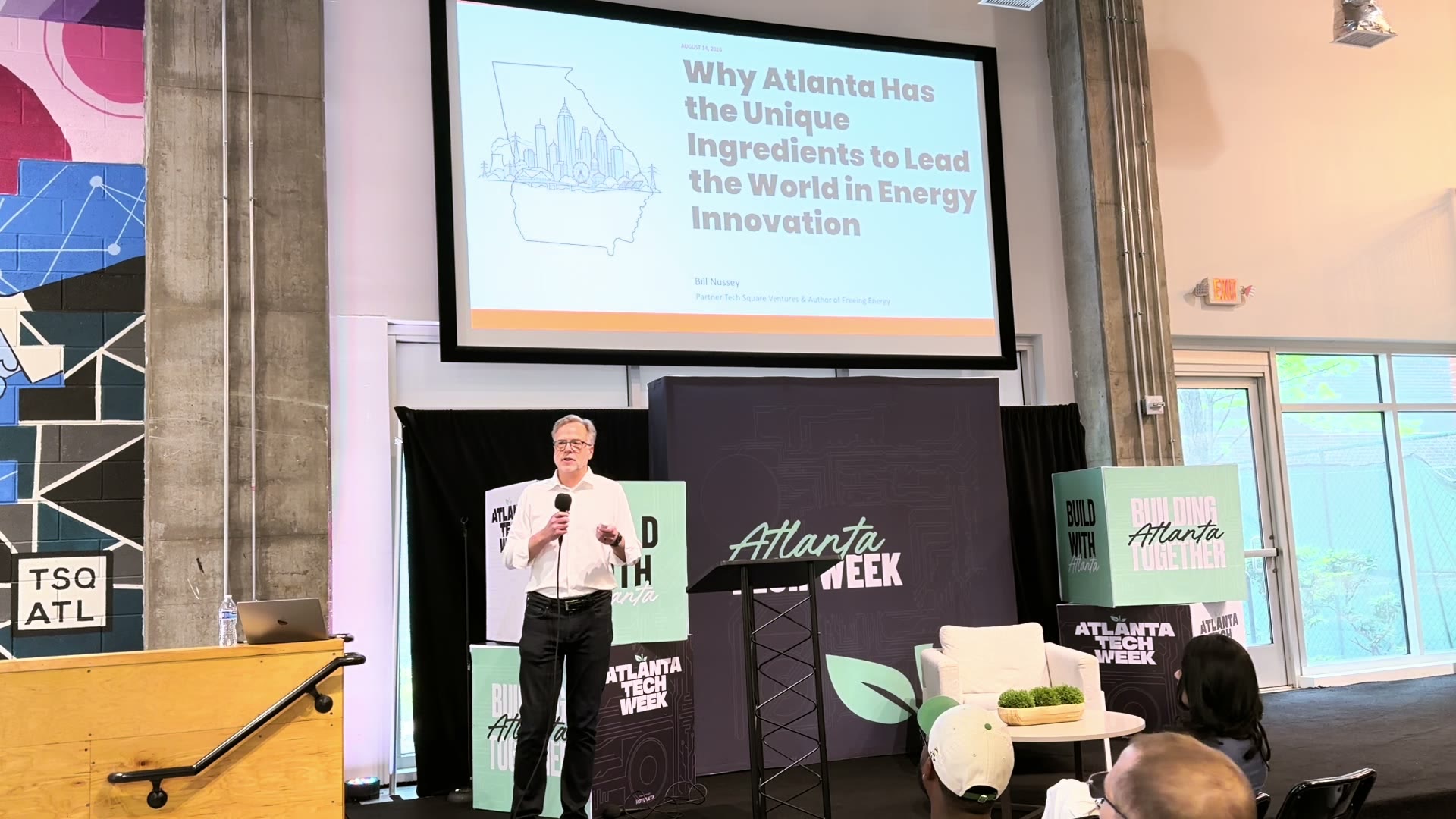
Could our region become the energy tech capital of the world?
That is the question I set out to answer at my Atlanta Tech Week talk, in front of a room of founders, investors, and corporate innovators.
The short answer is yes. And the part that surprised me and surprised many folks in the audience is that we already have the hardest parts in place… we just need to weave everything togther.
Here are the slides (download button at the bottom):
Here is the case I made, with a little more detail on each part.
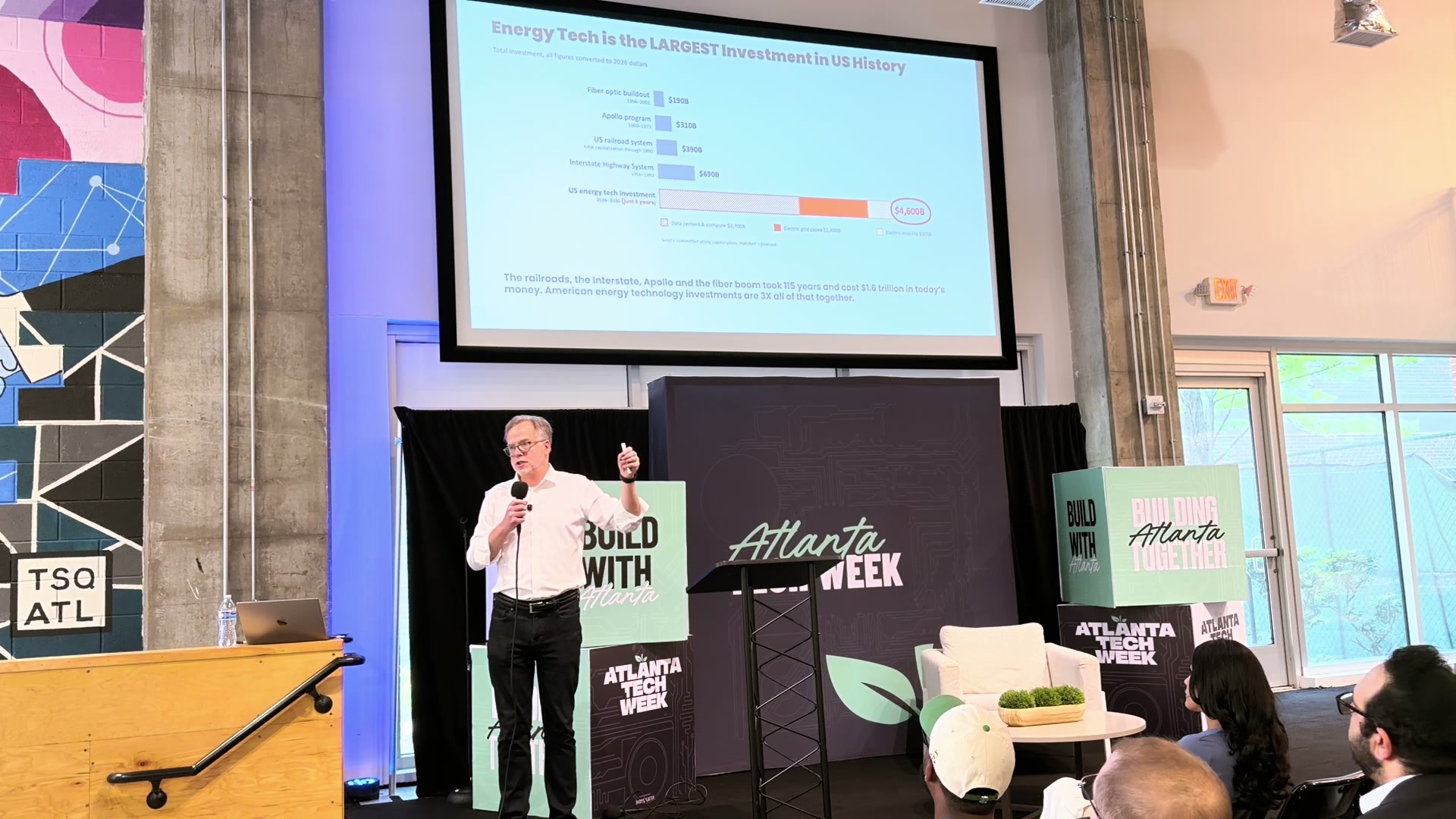
Energy tech is the largest investment in American history
I could have talked about fintech, or bio, or hard tech, or AI. Atlanta does all of them well. I picked energy because energy sits underneath every one of them. Health and comfort, clean water, food, transportation, the entire digital world: all of it runs on electricity, and most of us never think about it past the light switch.
Then there is the number. Put the great American build-outs side by side, in today’s dollars: the fiber optic boom cost $190 billion, Apollo missions were $310 billion, the entire US railroad system $390 billion, the Interstate Highway System $690 billion. Together that is about $1.6 trillion, spread across 115 years.
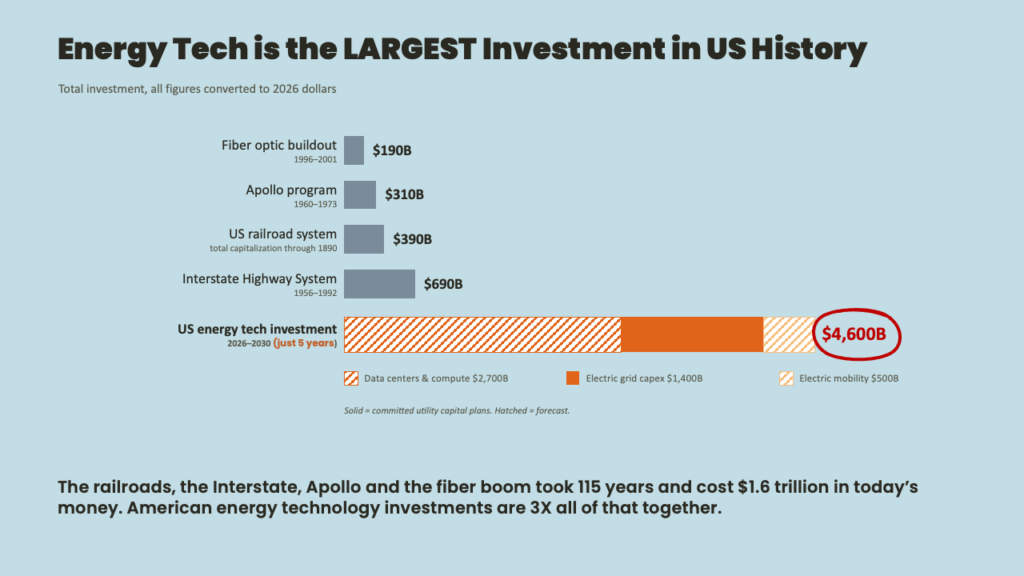
American energy tech investment from 2026 through 2030 is $4.6 trillion. Five years, and roughly three times everything above it combined: $2.7 trillion into data centers and compute, $1.4 trillion of electric grid capital plans, and $500 billion into electric mobility.
The objection I get is that this is an AI bubble. Maybe. But the bulk of that money is committed and contracted by serious companies with deep balance sheets, not a forecast..
Georgia is one of the few places that can run the whole lifecycle
Over a recent coffee, Henk Both at Anzu Partners, laid out this powerful but elegantly simple vision. Georgia is one of the few (or maybe the only) places where we can deliver the entire ecosystem and lifecycle: invent, launch, fund, manufacture it, deploy energy tech innovations. Almost nowhere can do all five. We can. Here are the first two, and the next section is the other three.
Invent. Ask a room in Atlanta where Georgia Tech ranks nationally for energy research and nobody guesses number one. The fact is that US News ranked it number one, with more than a thousand energy researchers, and a seat in one of only eight DOE critical mineral consortia in the country. My venture firm, Tech Square Ventures, just invested in SSNF, a nuclear fusion supply chain company out of Georgia Tech that is now building product in Marietta. That is the whole pipeline in one company: university research, a catalytic entrepreneur, and a plausible shot at being the next Georgia unicorn.
Launch. We have real accelerants and accelerators: ATDC, Engage and Tech Square Ventures, the Cox Cleantech Accelerator, the Georgia Cleantech Innovation Hub, Georgia Tech’s Advanced Manufacturing Pilot Facility and Sustain-X, and the new Cleantech Campus at Seapoint in Savannah.
Georgia has more money flowing in than anyone realizes
Funding is where every conversation about Atlanta stalls. We do not have many energy tech venture funds, so people conclude they should go to Silicon Valley. I think that is exactly wrong.
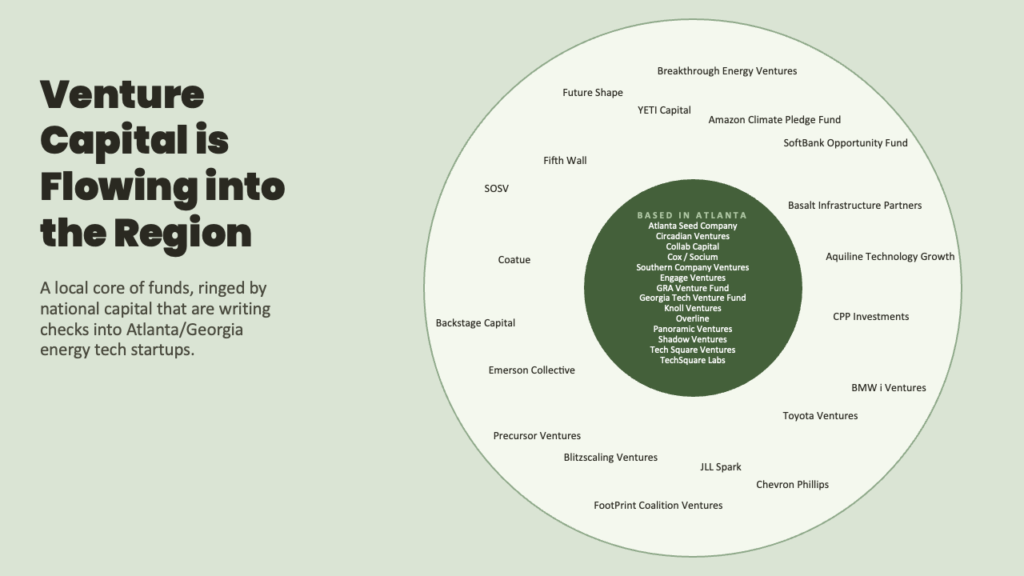
Start with venture anyway. I took the Georgia Cleantech Innovation Hub’s company list and mapped every investor who has written a check into a Georgia energy tech startup. There is a local core, ringed by national firms most people would recognize, many of them repeat investors here. No, we do not have a homegrown Energy Impact Partners, though EIP does run a strong hub here with amazing people. My argument is that we do not need one. It would be nice. It is not necessary.
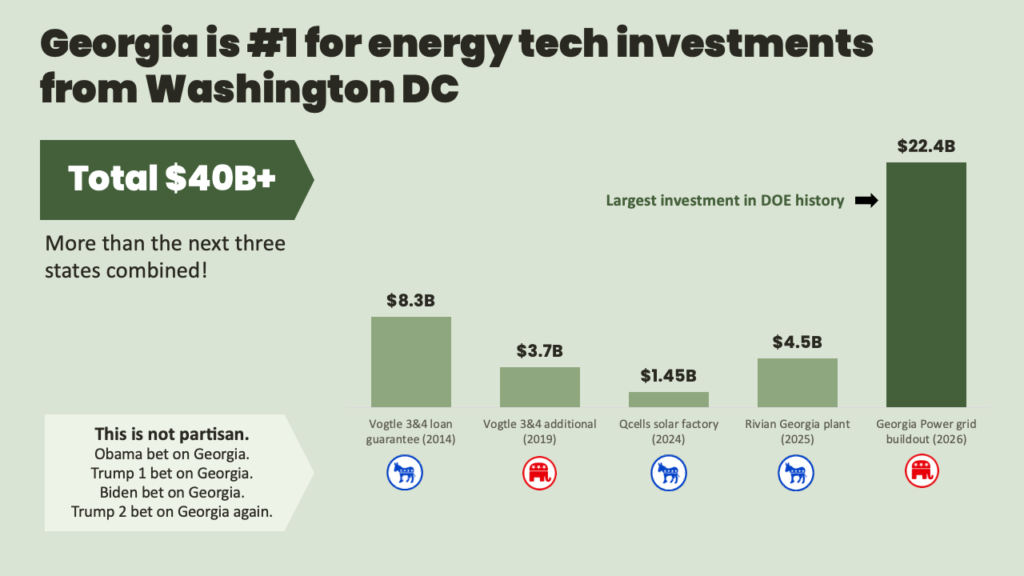
Georgia has received more federal money for energy tech than the next three states combined
Look at what we do have. Georgia has received over $40 billion, including $22.4 billion Georgia Power grid buildout in 2026 that is the largest investment in the history of the Department of Energy. These investments cross four presidential administrations: Obama bet on Georgia, Trump bet on Georgia, Biden bet on Georgia, and Trump bet on Georgia again. It is four separate administrations and two political parties reaching the same conclusion about where federal energy money works hardest.
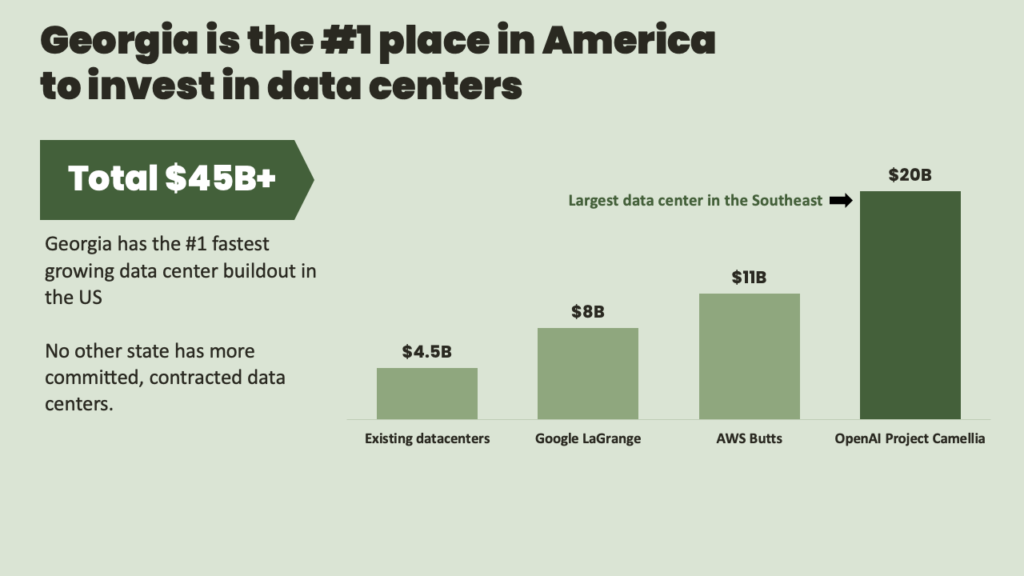
Georgia is the best place to build data centers in the U.S.
More than $45 billion is signed and contracted here, including OpenAI’s $20 billion Project Camellia, which will be the largest data center in the Southeast. Virginia and Texas still have more total capacity, but Georgia is the fastest-growing build-out in the country, and our numbers are contracts with credible, bankable off-takers rather than announcements. The figure for companies that merely say they intend to come is north of $100 billion. I left those out.
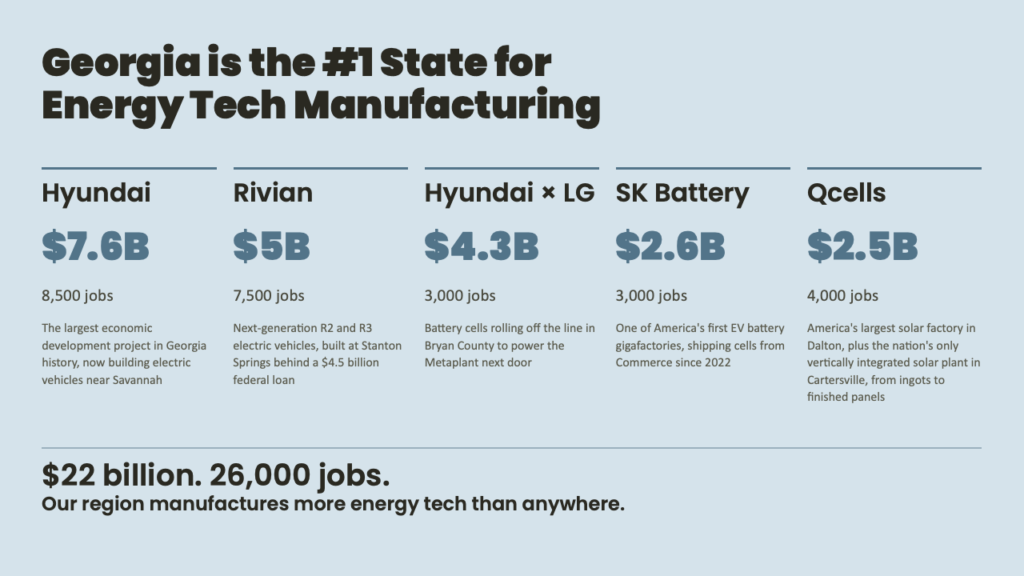
Georgia is the #1 state in America for energy tech manufacturing
Hyundai at $7.6 billion and 8,500 jobs, Rivian at $5 billion and 7,500, Hyundai and LG at $4.3 billion, SK Battery at $2.6 billion, Qcells at $2.5 billion and 4,000 jobs. About $22 billion and 26,000 jobs. Cartersville is the only place in the United States that takes solar from ingot all the way to finished panel.
But what if you don’t care about or even care for some of these projects like power plants and data centers? I can argue for and against both, BUT the big point is that the money is coming either way. When a river that size runs past your front door, you put a water wheel on it. A 1% improvement on a flow this big creates unicorns. Knock on the door at Georgia Power, or Southern, or Oglethorpe, or a hyperscaler, and a small innovation is a large company. So, to say this a bit differently… it’s less about what all this money flowing into Georgia is building and more about the sheer volume of money creates a host of additional opportunities for all of us to help accelerate energy tech innovation.
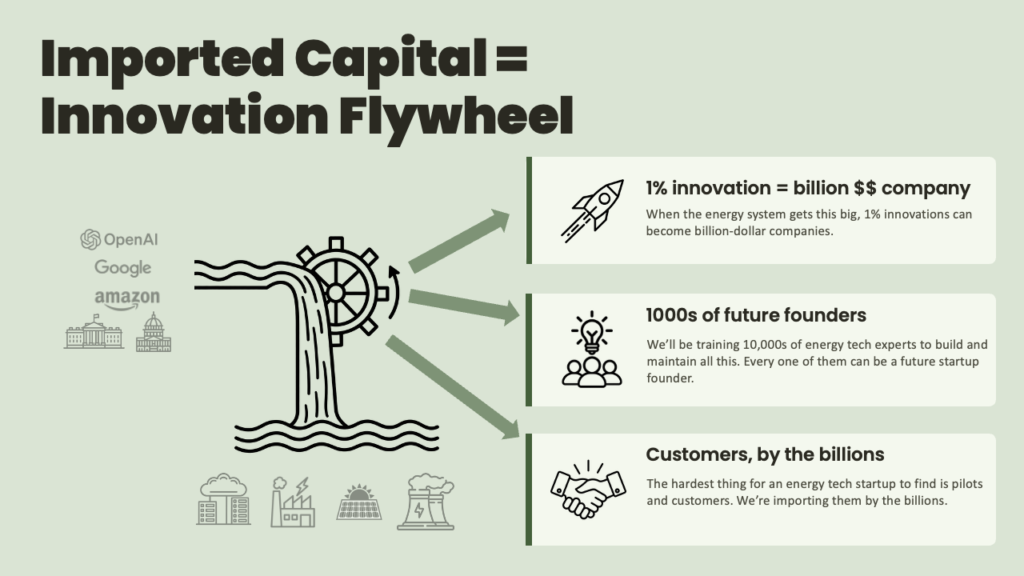
The second-order effects are bigger still.
- We are at the precipice of training thousands of the most expert energy tech founders in the world.
- We will have the one thing energy tech startups struggle find… a pilot and a first customer… imported by the billions.
Atlanta’s superpower is that people here will take the meeting
The deploy step is where our least obvious advantage lives. Georgia is third in the country for Fortune 500 headquarters, which is nice on its own. What makes it rare is that our big companies do not compete with each other. New York’s Fortune 500s are mostly financial services. Houston’s are mostly energy. Atlanta may be the only place in the world where you can put Delta and Chick-fil-A in a room, or Coca-Cola and Georgia Power, and everyone can open the book completely. (See my LinkedIn post on Georgia is Poised To Lead the World in Corporate Innovation.)
I have watched it happen. At Engage we once had the heads of strategy from five giant companies share their actual strategies with each other, something none of them had ever been able to do before, because, previously, the only peers they knew were competitors. Engage has now crossed 200 signed contracts between our startups and our corporates, which as far as we know is unique in the world. You could only build that here. And, these large corporates already align on sustainability and energy tech. It happens every quarter.
Underneath it is something simpler. The love language in this city is “let’s grab coffee.” I have worked in Boston and Silicon Valley and all over the world, and I have never seen this vibe at Atlanta’s scale and business-mindedness. It matters more than it sounds. Put a utility and a startup in a room almost anywhere else and the startup sees a dinosaur while the utility sees somebody with no idea about its ten thousand constraints, and the conversation ends. Here we get a second and a third conversation.
Remember why Bell Labs worked. Some of the greatest inventions in human history came from experts from different fields randomly sitting next to each other in a cafeteria. That’s what we do here in Atlanta and we are just learning to tap this potential… for energy tech innovations or anything else.
So what do we still need?
Five things. This is my to-do list, and it doubles as an invitation to anyone crazy enough to help.
- A unified vision. When I started on energy nine years ago, the players here behaved like gas molecules in a container, bouncing around, occasionally colliding, mostly oblivious. We need one simple story about what this state can do. We do not have one today.
- A coordinated angel network. Big venture follows small checks, not the other way around. The Cox Cleantech Accelerator is one of the best things to happen to this region and it put us on the map. Formalize that across a large group of people who can also mentor, and it compounds.
- A dedicated home base. We have wonderful spaces. We do not have a greenhouse. I am not sure how badly we need one, but I know that if we had one it would change everything: the place visitors from other countries come to see how Georgia does it, and the place a founder walks into and thinks, this is where my thing gets built.
- A founder school. I see thirty or forty energy tech pitches a week. There is no good baseline anywhere on what being an energy tech CEO actually requires, which is the reason I wrote Freeing Energy in the first place.
- Talent retention. Georgia Tech, Emory, and UGA train some of the brightest minds in the world, and the first thing many of them do is move to California. So far our strategy is wishing.
So that is my mission, and it is audacious enough to be a little silly: I want Georgia, with Atlanta at the center of it, to become the energy tech innovation hub of the planet. Nobody is paying me to say it. I have seen the microcomputer, the internet, and the mobile phone arrive, and I do not believe any of those revolutions will match this one in scale or impact. Our region already has nearly every part. We start by realizing what we have and then we get people together. That’s it.
Let’s go.
Watch a recording of the talk right here
From the stage
Sources
- US News & World Report research rankings, and Georgia Tech. Energy research rank and researcher count.
- US Department of Energy Loan Programs Office. The Vogtle loan guarantees, Qcells, Rivian, and the Georgia Power grid buildout, plus the critical mineral consortia.
- Company and state economic development announcements. Manufacturing investment and job figures for Hyundai, Rivian, Hyundai and LG, SK Battery, and Qcells.
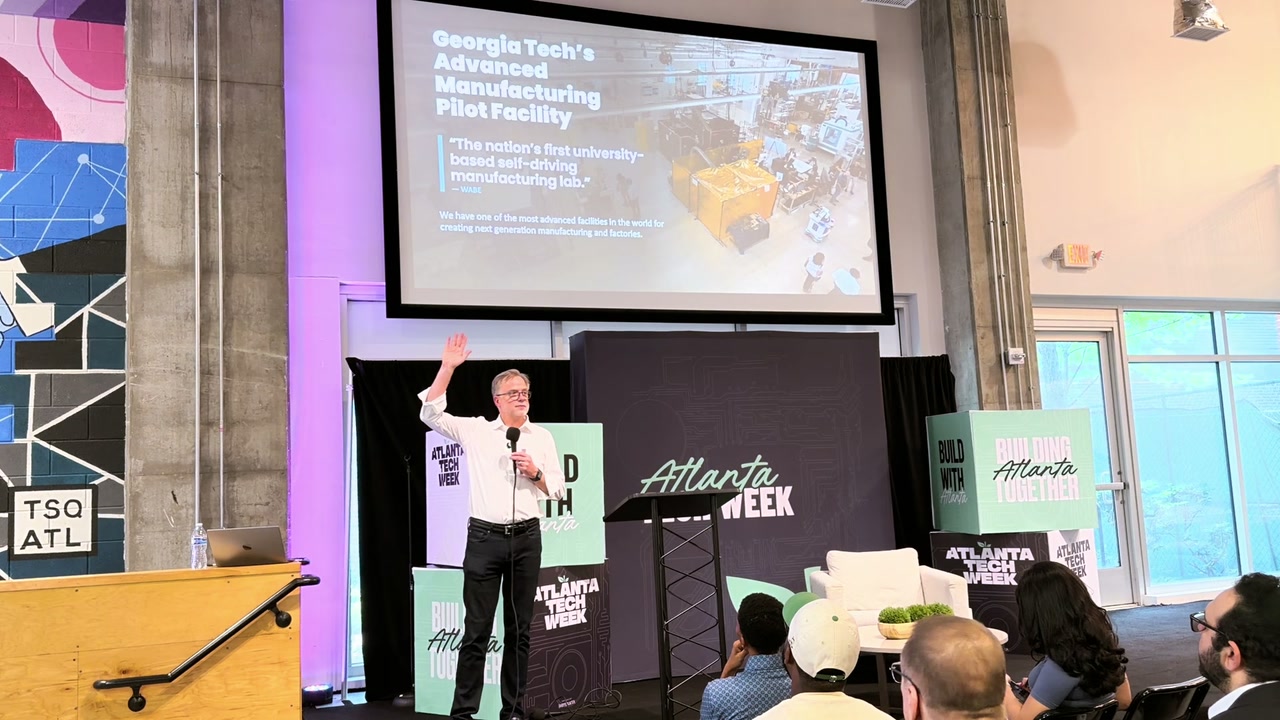
- WABE. Georgia Tech’s Advanced Manufacturing Pilot Facility as the nation’s first university-based self-driving manufacturing lab.
- Georgia Cleantech Innovation Hub. The energy tech startup and investor mapping.
- Engage. The count of signed startup and corporate contracts.
Full transcript
Everything above is the short version. If you want the whole thing, the complete transcript of the talk is below.
Read the full transcript of the talk
Transcribed from the room recording at Atlanta Tech Week, August 14, 2026. The talk runs 37 minutes. Filler words are trimmed and the wording is otherwise as spoken, with clarifications in [brackets]. Names and figures were checked against the slides.
Jump to a section
- Opening
- Why Energy
- The Scale of What Is Coming
- Why Georgia
- Invent It
- Launch It
- Fund It
- The One Percent Argument
- Pilots and Customers
- Make It
- Deploy It
- Why Atlanta
- The To-Do List
Opening
[0:00] All right, thank you guys. Pretty excited to be here. It’s a big opportunity for me. Thank you, thank you. Who am I? I know so many of you, but I’m Bill Nussey.
[0:11] I am a partner at Tech Square Ventures, which is one of the leading venture firms here in the Southeast. I’ve helped lead Engage, which is a very unique accelerator program that’s based here in the Southeast. But for those of you that have known me before that, you know that I’m a full energy nerd. And I wrote a book called Freeing Energy. I had a podcast by the same name. And I am really excited about the privilege to be able to share with you all the story that got me into energy.
[0:42] Energy is my deep passion. And I believe it has the chance to unlock crazy amount of growth at business, jobs, businesses, et cetera, across Atlanta, Georgia, and the Southeast. So I actually even brought my sports jacket because I wanted everyone to think I was serious, but it’s way too hot. So I’ve just rolled my sleeves up and we’ll go from there. So the first question I wanted to ask answer was why energy, right? There’s a lot of cool things we do in Atlanta and Georgia.
[1:14] There’s a lot of reasons. We can go to FinTech and bio and hard tech and AI. There’s just a lot of really interesting spaces. So if I do my job today, a few of you are going to walk away thinking, wait a minute, whoa, energy might just be the most interesting area of innovation in the world. And we here in Atlanta and Georgia may just have more advantages to dominate in this massive business than anywhere else on the planet Earth. So, and I will hopefully, I haven’t done this before.
[1:51] So this is the first time I’ve presented this. This is the first time I’ve presented about two thirds of these ideas. So I’m going to do my very best to finish in about 42 minutes and we can have time for Q&A, but no promises. So years ago, I sold my company to IBM and I had this epiphany that I needed to do something that really mattered with my life. I had a good Rolodex. I had a little bit of money.
[2:12] And I said, what can I do? It’s going to make an impact on the world. It’s going to sort of get me charged. No pun intended. I looked at a lot of things, social impact. I looked at health tech.
[2:23] I looked at ag tech. I obviously thought about venture in the broadest sense.
Why Energy
[2:28] And what I realized is that energy is actually the center of every single thing we do. Go back in human history when energy was first sort of captured with water wheels and then the steam engine and the elevation of society for mostly good, but certainly some ills is a result of energy becoming abundant and cheap and available everywhere. The story of America is energy, electric energy becoming available across the country under FDR and that follows the arc of America growing into a world power. And so a lot of people take it for granted. You flip your light switch on somewhere, somewhere there’s a giant power plant burning something or maybe solar panels and then it works. It turns out that you are in the region of the world that we may have more opportunities there to make that light switch be reinvented than anywhere else.
The Scale of What Is Coming
[3:22] So just to give you a sense of the scale, these numbers show you how much money has been invested in some of the most powerful infrastructure projects in American history. Putting someone on the moon, building the entire U.S highway system. The number at the bottom is contracted commitments to the grid, to electric mobility, and AI data centers. And we’re going to talk about the pros and cons of these things because they all have pros and cons, but essentially the amount of money we’re going to spend just in the next five years. Even if things collapse and it turns out it’s an AI bubble, all this is committed and contracted. We are going to see more money flow into electricity, tech, energy tech, in the next five years than all the projects that we’ve done as a country at scale in our history together.
[4:13] So a lot of people don’t look at these numbers and part of my job here is to have you say, “Holy cow.” That’s the next five years. And why Georgia?
Why Georgia
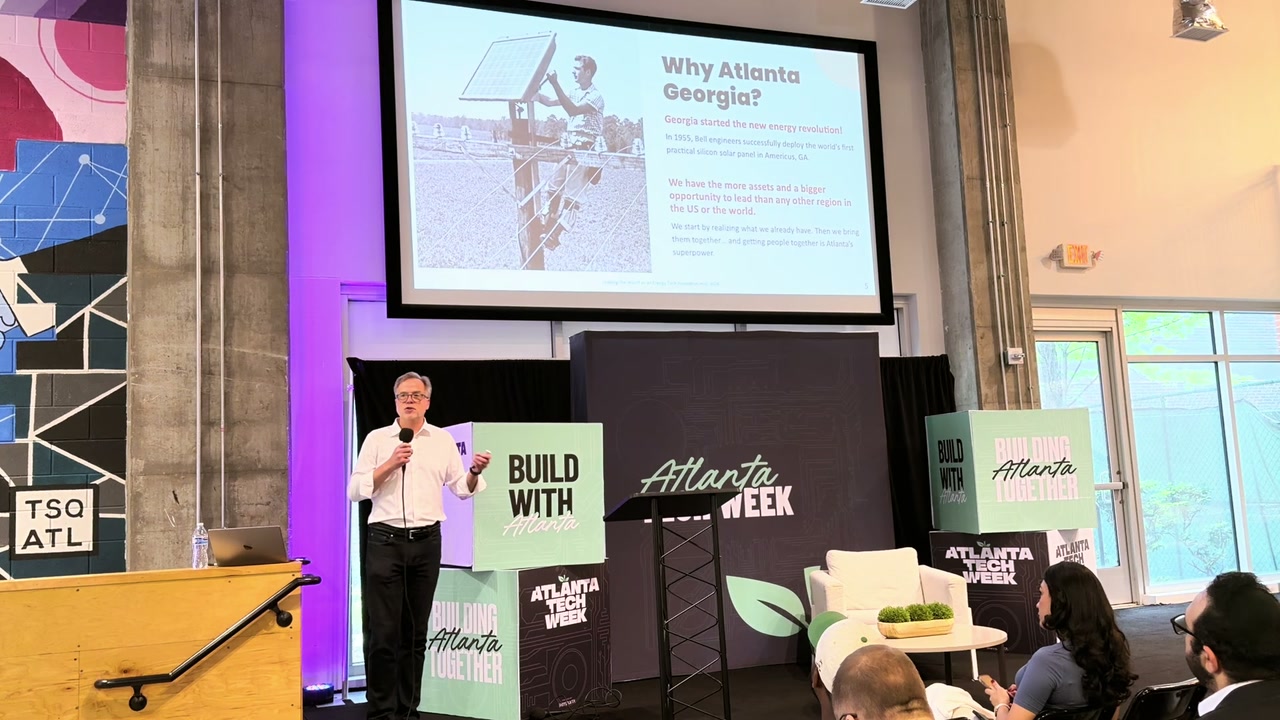
[4:23] Well, one cool fun fact that not a lot of people know is the first active commercial solar project in the planet Earth took place in our fine state here in America’s Georgia. That’s Bell Labs putting up a solar power measuring system for the telephone company. And so, in many ways, our state has been the place where energy, the brand new types of energy get born. But much more importantly, and for the majority of what I’m talking about, today, we have a unique set of assets in this state that are unmatched in the world, unmatched in the country. And I suspect most of you don’t know two thirds of them. Frankly, before I started writing this, I didn’t know a third of them.
[5:05] And so the story is pretty compelling to me, and I hope you guys get excited about it. So my goal, my mission, personal mission, is that I want to see Georgia and the center of Georgia, Atlanta, become the energy tech in innovation hub of the planet Earth. And it’s audacious, it’s silly. It’s the first time I’ve said that in public. Y’all can laugh at me when I’m not in the room. Like, what the hell is he talking about?
[5:30] He’s deranged, delusional. But I love giant missions. And so many of you here have helped me with my mission. And this is the culmination of that to go forward. My partners at Tech Square Ventures are incredibly supportive. You’ll see our firm do a lot more investing in this area than we’ve done in the past.
[5:47] In order to make this ecosystem work, we have to do five different things. Thanks to Henk Both, at Anzu Partners who gave me this model and he was the one that said Georgia can do this.
Invent It
[5:56] He said Georgia is one of the few places where we can invent it, we can launch it, we can fund it, we can make it, manufacture it, and we can deploy it. And in the next 10 or 15 slides, I want to convince you there’s no other place in the world that’s better able to do this lifecycle than where you’re sitting right now. So how do we invent this stuff? Does anyone know where Georgia Tech ranks in the United States for energy research? Number one, number one in the country by U.S. News.
[6:33] Just down the street over there, we have over a thousand researchers working on energy. There is nothing like this in the United States. Some of this is hydrocarbons and fossil fuels, some of this is nuclear, some of this is modern solar and battery systems and control systems, a lot of control systems, but we are inventing the future of energy a mile from here. And you walk by it every day and you think of all the amazing things we do at Georgia Tech, you don’t realize this is actually one of the most incredible things that Georgia Tech is capable of. So we have the ability, and we are, inventing the future of energy every day here. It’s pretty amazing.
[7:09] So, so say you have an idea. We just invested in a, my firm just invested in a sort of, air quotes, nuclear, nuclear fusion company called SSNF. They just opened up and started to build some products that are in the, in the supply chain of nuclear fusion up in Marietta, straight out of Georgia Tech. Amazing story, case study of how the university can do research, how a catalytic entrepreneur can come into the middle of that and create a company that could well be the next Georgia unicorn.
Launch It
[7:40] So, how do we launch it? Well, as my friend Andy, who I saw here, said we call them Accelerants. We have a whole range of things going on here. ATDC across the street, Engage and Tech Square Ventures across the street, but Hannah here from Cox and Jack. So, we’ve got a lot of these places where if you’re an entrepreneur or a scientist, you’ve got an idea, there’s a door to knock on. And, but I, there’s actually quite a few more than this, but I wanted to make the point here and to challenge all of you who are in this ecosystem, and I, I am in this ecosystem, so I’m saying this to myself, we’re, our success is going to be less about the count.
[8:16] It’d be great if we had 25 or we had 50, but we don’t have Greentown Labs. And if you know the energy tech space, Greentown Labs is the epicenter of the Boston energy tech community, and it is, and it’s the, it is created, the waves that it has created in the world are nearly hard to, nearly impossible to measure. And so, we need organizations like Engage to put energy tech companies in front of corporates, which we’ll continue to do, but there’s probably something bigger that a lot of us are talking about doing. The Georgia Cleantech Innovation Hub is trying to create that center spot. There’s a lot of efforts going into the Super South conferences, trying to gather people together. Somewhere in all that, what maybe will emerge is take us up a couple of tiers and how we can impact those companies that are coming out from across the street and from the other great universities and the other great people who are inventing the future of energy.
[9:11] We’re already doing it you know, everyone points to Sila Nanotech is a great Georgia Tech. Sadly, they moved to the West Coast, but we still call them, we still, they were still born here this is just six companies that happen to know well all of them, but there’s dozens and dozens and dozens of energy tech companies all these companies have raised a ton of money. They’re all thriving. If you haven’t heard of some of them, how many, how many people here have heard of every one of these companies? Okay, so not enough. The fact is that these companies, I know them all.
[9:43] They don’t talk to each other very much. I don’t know that there’s a sense of community among them, yet they’re all facing a lot of the same challenges, and so I think there’s an opportunity to connect the dots, more than we have.
Fund It
[9:56] Funding. This is where everybody gets hung up. We don’t have a lot of venture funds here for energy tech, and so that’s where everyone stops. Well, we should go to California because there’s a whole lot of venture funds. There’s a lot of companies out there that venture fund energy tech startups. That’s where we should go and let me tell you why that’s just wrong.
[10:16] You know, first of all, we do have, venture capital, but we also have other kinds of funding and I’m, it’s not the way I thought about it until I started this research and it changed the way I think about where the best place to be, the best place to get funded is because I have been a venture capitalist in my career. I’m one now. And so of course we are the, when you’re a hammer, everything looks like a nail, but the truth is we have more opportunities to create funding and pilots in this state than anywhere else. But let’s just start with venture. So this is a bit of an eye chart, but I went and asked Claude and it ran for an hour and a half. And I said, show me every company.
[10:51] I took Andy’s list from the Georgia Cleantech Innovation Hub and I said, show me all the people that have funded companies in Georgia, starting with the green circle, which is Georgia and Atlanta based VCs, and then look across the United States and find out people that have flown in and then just pick out names that people are likely to have heard at least once or twice. But the number is actually four or five times more than this. But these are the ones that the ones around the edge there are very well known and respected firms if you don’t know the space. And in many cases have made multiple investments in Georgia based energy tech companies. So the good news is, while we don’t have any massive iconic energy impact partner types firms here, although Energy Impact Partners has a great hub here with some fantastic people. We don’t have they’re based in New York, not not Atlanta.
[11:37] My argument is that we don’t really need it here. It would be great to have it, but it’s not necessary for us to be successful. Because what we do have is an absolute ton of money coming into our state. So the next three slides are going to require you to sort of reset your thinking a little bit. So bear with me. Oh, crap.
[12:00] All right. So, I have no idea. It worked fine yesterday. So Georgia has received more money from Washington DC for energy tech than any other state in the country. It’s received more money than the next three states combined. Okay?
[12:21] So maybe you love nuclear and you think this is great. You love utilities and you look at these big numbers and you think this is great. Maybe, hey, you know, I don’t, we don’t need more of that old stuff. But bear with me because I think this is a much more important point. And again, I want you to be clear that these investments in our state have come across four different presidential administrations, two different political parties. This isn’t about, you know, let’s pay off our buddies and help them out.
[12:46] This is where is the best place for the federal government to put its money when it wants to be innovative on energy tech and there is no close second to where we’re sitting right now. That’s a, you know, is Washington D.C the best arbiter of things like this? I don’t know. But still, I think this is an incredibly powerful example. So there’s one more. Again, we can have a debate afterwards about the pros and cons of data centers.
[13:11] But Georgia is number one in two critical areas. We’re the fastest growing for data centers. We sit behind Virginia and Texas in total numbers. But Virginia and Texas have different legislative regimes. They have different utility laws. And Georgia is signing massive long-term contracts that are guaranteed by what they call credible bankable off-takers.
[13:34] And so when we put up a number like this in Georgia, this you can take to the bank. This is not a speculative number. The number that actually is people that say they’re going to move here and put it is over $100 billion. So I just limited it to people that have signed giant contracts. The largest data center in the southeast is going to be in Georgia. OpenAI is $20 billion.
[13:57] So again, data centers have a lot of issues. I don’t want one in my backyard. What’s going to do to my water? Is it going to take up all the water? Is it going to raise my electricity prices? These are excellent conversations to have.
The One Percent Argument
[14:08] We can have them after I’m done. None of these are panaceas. Building more nuclear plants, building more data centers, it isn’t a magic solution, and it creates a lot of problems. I want to be very clear that I’m not here to sell you on that. What I am here to sell you on is this. When you have money like this flowing by, you just put a little water wheel on this money.
[14:30] I wonder why people like nuclear power plants so much because they’re so giant and expensive that the number of places that you can, build businesses around that money flow and fund pilots and fund energy tech startups and teach people to be energy tech leaders. So three really powerful points for me. When I was writing my book, Freeing Energy, one thing I realized was that everyone was going after these, the stories we read about in TechCrunch or in the modern media, they talk about this, we’re going to make fusion work tomorrow. We’re going to have flying cars, all these things. But you know what? Those are usually many years away, and even if they work, they’re probably less economic, less appealing than you think.
[15:13] And the really boring problems are actually where the best companies get created. Anyone know what Sila Nanotech does? I mean, it’s incredibly technical and probably very difficult to explain at cocktail parties. But one of the most exciting, highly funded companies to come out of the state. If you improve, if you bring just 1% innovation to the flow of money that’s coming here, you’re creating unicorns. When you have this much money coming in, you knock on the data center doors and you knock on Georgia Power and you knock on Southern Company and Oglethorpe and others, if you can just have 1% improvement on anything, you’re creating unicorn companies.
[15:53] So it’s not that when the money comes down the bottom, it’s coming towards these power plants and data centers. Again, we can, if I was king of the world, I probably would do it a little differently. But the fact is the money’s coming here. It’s contracted. And our ability to use that to, create unicorn class companies by even having tiny changes. We’re going to have to train tens of thousands of people that aren’t in this room today to become energy tech experts.
[16:19] And they’re going to work for the utilities, they’re going to work for the data centers. Every day, they’re going to go in a data center and make sure all the gauges are the right way. And they’re going to be talking to each other. They’re going to be in the utility, like, let’s send some power this way. And what are we going to do here? They’re going to get itchy.
[16:30] They’re going to say, I want to start a company. We are at the precipice of training thousands of the most expert-level energy tech founders in the world. That’s what happens when you put the wheel on all that money flowing.
Pilots and Customers
[16:50] And every energy tech, I’ve been in this room multiple times talking to energy tech startups. And the problem they always have is no one’s going to test my stuff. It’s actually really hard. How many of you actually have an energy tech company? Any of you have them? So it stinks, man, getting someone to sign up to take a bet You know, what if it doesn’t work in year 25?
[17:09] You’re like, oh my gosh, I got to get their payroll next week. And I live in this world as an investor in those companies. I don’t know if OpenAI and Google and AWS and Southern Company and Georgia Power are going to do a lot of pilots. But I know those companies and I know the folks at Georgia Power and Southern. I was with their innovations group this week. They are looking for stuff with the largest amount of money to ever flow into utility in the history of the United States.
[17:37] The couch change that’s coming in is going to be dozens, hundreds of pilots, hundreds of proof points that we can take, those start-ups can then take across the United States and the world to create unicorn energy tech companies. So the ability to run pilots, we’re going to have the opportunity to have customers the likes of which I don’t think anyone yet has their head around. So where the money goes, we could have a really good debate. I’m glad to have it. I can argue both sides that data centers are great, data centers are terrible, but the fact is they’re coming. Do we need more nuclear?
[18:08] Do we need more natural gas plants? I could argue we don’t need them. Maybe we do. I can take both sides, but the fact is they’re coming. So our point isn’t to sit out there and say, golly, I wish we had a lot of solar, and I do say this, but not in this situation, but I wish more of those gas plants were solar plants. That would be great, but it’s not.
[18:24] Right now it’s going to be gas plants. But the fact is, as money is flowing in, our ability to tap into that is unprecedented and has never happened in the history of the country at this scale.
Make It
[18:38] Anyone know the state that is the best for cleantech manufacturing in the country? Anyone? Anyone? You guys, you guys get it, right? So the number one, so we had the Engage board meeting. Engage is this, this organization is accelerator with the Coca-Cola, and UPS, and Delta, and Georgia-Pacific, and Georgia Power, and all the big companies have their board, their CEOs sit on our board, and they’ve all contributed money, and we learn from them the trends.
[19:05] And when we see something at Chick-fil-A and Delta, and Coca-Cola, that’s interesting to all of them, it could be in logistics, it could be in HR. I, and my colleague David, with help from Priyanka and others, look at startups that fit horizontally in the sustainability and energy tech space. And so, we had a board meeting, and I, you know, I used my, I’ve led Engage for four years, I used my position there, and so we got the board meeting with a bunch of Fortune 500 CEOs at the Georgia Tech’s advanced manufacturing pilot facility. How many people know what that is? All right, so not nearly. WABE, which is a news station, said this is the first university-based self-driving manufacturing, one of the most advanced manufacturing facilities in the world.
[19:55] If you’re designing a new factory, if you want to manufacture something, there may be a handful of places where you can go and have access to the robotic and test and control systems that you can go And it’s just down the road there. We could actually just get in a bunch of cars and go see this and knock on the door. And this is some of the most amazing. I brought these, you know, the C-suite executives from these giant companies. And I remember one of them, the robot was standing right in front of me standing here and the robot’s like stopped right in front of him and it’s waiting for him to move. And then one of them started to get aggressive and the robot backed up just to see the robot was delivering a part from one place that had been milled to another place where it was going to get measured.
[20:33] And so when we talk about manufacturing, this isn’t just energy tech, but this is an example of what we are doing at Georgia Tech, an invention center that is going to help everybody in energy tech think about the future of how do we make this stuff at scale. So there are reasons that some of the largest cleantech manufacturing companies in the United States are based here. This is the only place just up the road here, not technically Atlanta, just up the road here is the only place in the United States where we’re going to get this stuff at scale. In the United States that we make solar cells all the way to panels. Just one place in the United States. And that’s recent.
[21:13] I mean, there’s so many reasons why they chose here. In some ways we’ve made it more difficult than we should. I wish there should be more. But this is still, this is the place. One of the largest battery manufacturers, several of the largest battery manufacturing facilities in the United States. And while the federal government is not really super excited about solar anymore, the federal government still loves batteries.
[21:33] And so you’re going to see battery factories. And when I got into this, work 10 years ago, batteries were all about EVs. And a lot of people think I have an EV. They’re phenomenal. I don’t know why anyone doesn’t drive an EV. But EVs have come out of favor.
[21:46] And so now all these battery capacities are being shifted over to grid scale batteries. And it always cracks me up when someone just like, oh, we just had a battery and we cut down our costs and our peaks. And like, yeah, that’s what it does. And it’s really cheap. You don’t need to put all this incredibly expensive burning things. You can just put a battery in place.
[22:07] And everything gets cheaper. So when I was doing my podcast, my nickname became Battery Bill. And my saying became batteries are like bacon. They make everything better. And so we are making, and we also recycle. We have one of the top recycling places for batteries here in Georgia as well.
[22:24] So most people don’t know this. You might drive this if you’re going up to South Carolina. You know, you’re going for about a mile. There’s a big gray building on the side of the road that’s SK. One of the most advanced battery manufacturers in the planet. Right here.
[22:37] So more places have decided, more businesses have decided to manufacture clean tech here in Georgia than anywhere else in the United States. So these facts mean that there’s money flowing in here at a level. That means there’s expertise from all over the planet Earth. It’s converging. It’s going to come to events like this. It’s going to go to the Braves stadium and watch a baseball game.
[22:58] But they’re going to become part of our community, and they’re going to run into you, and one cocktail dinner or one thing at your kid’s school event, you’re going to be sitting next to someone. And they’re going to say, “Yeah, I really want to start a company.” And someone’s going to say, “You know, I have this invention.” And that’s the thing that’s the most unique about this community, is those conversations happen better here in Atlanta than anywhere else in the world.
Deploy It
[23:22] And so the final point is deploy. We have some of the most aggressive data center builders here in Atlanta and Georgia and in the United States. As I said earlier, we’re the fastest-growing data center region in the country and if you, when analysts look at data center buildouts, Georgia stands unique because, again, you can like it or hate it, but when we are the place to do business and they can come here and sign a contract with Georgia Power, Georgia Power says you’re going to pay for virtually all the stuff that’s going to add costs and I’m sure those agreements are filled with imperfections that all of us could be critical of, but the fact is giant contracts, billions, tens of billions of dollars of contracts are being signed by companies that are good for the money, not as speculative startups. So we have some of the largest data center companies like QTS in the world here. We’re building some of the largest AI data centers. This is all opportunities to pilot, to hire, to find next startup founders.
[24:24] This is all happening. And then, of course, we have corporate buyers. And so I don’t know if any of you are familiar with Engage, but it’s something I’m incredibly proud to be part of. There’s a lot of accelerators where they make introductions. Startups get to talk to corporates, and sometimes they form relationships. We announced three months ago that we crossed 200 signed contracts between our startups and our corporates.
[24:51] Far as we know, that’s unique in the world. And there’s a reason that you can only build Engage here in Georgia. This is very important because it applies equally to energy tech. Georgia is number three in the United States for Fortune 500s, which is awesome. If you do Google Fortune 500s in Georgia, you’ll be shocked at the number of companies that are here besides the obvious big ones like Coca-Cola, UPS, and Home Depot, and Delta. We have a lot.
[25:23] Number one is New York. Most of the Fortune 500s in New York are financial services. Number two is Houston. Nearly all the Fortune 500s in Houston, not all of them, and I’ll include Dallas in a big circle, are energy, right? Atlanta is the only place, as far as I know in the world, and I’ve researched this for years, where every one of the large companies is largely non-competitive. And you’ve got to get your head around that.
[25:52] So if you want to create real innovation across companies, you put Delta and Chick-fil-A in a room. You put Coca-Cola and Georgia Power in a room. Groups like that have almost never had the opportunity to meet their peers in non-competitive companies. Their only opportunity is to go to a trade conference that’s all about consumer packaged goods. They’re all about airlines. So you have to be pretty circumspect about sharing what you’re thinking about.
[26:19] What are you doing with AI? How are you handling that? Because it’s your competitor, right? When we at Engage get all these companies together, they can open the book entirely because they’re all non-competitive. One of the greatest moments of my time at Engage was we had the heads of strategy of five of these giant companies. And they all sat in the room and they shared their strategies.
[26:41] It was different languages. Like some of them have different industries, but they had never in their careers had a chance to hear what this core deep strategy of an industry they’d never heard of. And what was magic and the reason it was so great was they saw the commonalities. And there was at least three or four things that we got to follow up on this, get our teams together because we can help each other. As far as I know, this is one of the few places in the world that those kind of conversations can happen. And so I think the corporate landscape here gives us an incredible advantage for every technology innovation we want to pursue.
[27:15] And I’ll be at the front of the list pushing for energy tech.
Why Atlanta
[27:22] All right, I’m going to land the plane as we like to say at Engage and with our love of Delta. So where do we go from here? The thing that makes this place unique, and I hear this from people who come from out of town all the time, is it like, “Let’s grab coffee.” That’s like the love language here. I think it keeps the coffee industry going, but people just get together and talk because they’re genuinely interested in each other. I’ve never, I’ve worked in Boston, I’ve worked in Silicon Valley, I’ve been all over the world. There’s some countries where I think there’s a similar vibe, but nothing with the scale and the business-mindedness of Atlanta.
[27:57] And so I think Engage is a proof that this works. It’s a proof that the culture is real and we can tap into it. So we can put a utility in the room with a startup and they know how to speak to each other and they have an innate respect for each other’s role. Right? It’s very easy for you to start to look at utility and say, you guys are dinosaurs and you don’t get it. It’s even easier for the utility to look at a startup and say, if you had the slightest idea of the 10,000 constraints I’m operating with, you wouldn’t even walk in my door.
[28:31] Right? And that’s why conversations start and stop so quickly. But here in Atlanta, we can have the second and third conversation. And I think this is that connectivity. Y’all remember the story of Bell Labs, right? Bell Labs invented radar and invented the telephone system, invented everything.
[28:46] And the secret of Bell Labs was that they co-mingled people with different expertises and they all ate together in the cafeteria. And some of the greatest inventions in human history came out of people sitting next to each other randomly in a cafeteria at Bell Labs. Alas, we don’t do that anymore at the country level, but I think Atlanta embodies that ethos and something we can lean into more than we do. So here’s Bill Nussey’s to-do list.
The To-Do List
[29:13] And perhaps this is an invitation for some of you crazy enough to come help. By the way, y’all taking pictures, I can post this somewhere. So I’ll post it. Where will I? I’ll post it on LinkedIn. No, I’ll post it somewhere when I started working on energy eight, nine years ago, and I started talking to people, utilities and startups and a lot of venture funds.
[29:40] And it was apparent to me that it was like a molecule, gas molecules in a container. They were bouncing all over the place, occasionally intersecting, but generally oblivious to each other and nothing but a bunch of silos. And also very little of the, I have, I understand enough of what you do, I’m interested to learn more. A lot more of the, you don’t, you’re not relevant to me, next please. And I think that one thing we can build, and it’s one of the projects that I’m prioritizing for myself, and a couple of other crazy folks that are helping me, is let’s, let’s see if we can at least come to something that feels, without being too broad, something that feels like this is what our state can do. By the way, I’m not getting paid by Georgia Economic Development.
[30:24] I have no upside in this other than I want to be part of the state. I want to be part of a revolution. And by the way, I’m old enough to have seen, you know, the first microcomputers, and I’m old enough to have seen the first internet. I was old enough, many of us are old enough to have seen the first rise of the mobile phones, right? So I’ve seen technology revolutions, and I believe there’s been no revolution that will operate at the scale and the impact of the energy revolution that’s underway. And we need to have a story.
[30:54] Don’t have a story today. So that’s number one. We need an angel network. You know, angel network proceeds, how are you going to get big VC money here? Well, let’s have a bunch of people writing small checks into energy tech companies. The Cox Clean Tech Accelerator is one of the best things that’s happened to the region.
[31:11] Cox is writing small checks, go Hannah, go Jack. And so they’re writing small checks in, and this is a, gives us, puts us on the country’s map. We can augment that. And as investors, Tech Square Ventures will be making investments, Engage will be making investments. But I think if we can formalize this across a large group of people, especially folks that could be mentors as well, that’s another thing we can do. We need a dedicated home base, right?
[31:36] So we have lots of really cool spaces. Engage, Tech Square just moved into a new space. Wicked cool. You know, the advanced manufacturing facility, if you’ve been there and you’re a robot nerd, way cool. But it feels to me like we don’t have a greenhouse, Greentown Labs, right? And I don’t know how much we really need one, but I know if we had one, it would change everything.
[31:59] That’s where the folks from the different countries come in and see how Georgia and Atlanta is doing it. That’s where the different universities come. That’s where the startups walk in and they’re like, “Wow, I want to be here. This is the place where my dreams are going to get built, and I want to see one of those get done.” We need it. We could really, really use it. With all due respect to everyone who’s raised your hand in the startups here, I see 30 or 40 startup pitches for energy tech a week.
[32:30] And I think that there’s an opportunity to provide more baseline information about what it means to be an energy tech CEO. Where can you go get funding? Now, there’s a thousand blogs out there, so maybe we just need to find a couple of good ones and point them at it, but I haven’t seen anything. By the way, the reason I wrote Freeing Energy, which is about how to do clean tech startups, energy tech startups, wasn’t because I wanted to write a book. I actually hate writing, but there was nobody that had actually gone and done the numbers and looked at the markets and explained what is an IRP and how do you think about the kilowatt. Like, I’ve met people in the electricity space that don’t know the difference between a kilowatt and kilowatt hour.
[33:07] And I’ve had founders who were proposing energy tech things that don’t know the difference between those things. And if, you know, you’re not in the industry and you don’t know, that’s fine, but there’s some basics in there. My number one page on my website is how electricity is like water, and it just explains using water as a metaphor what a kilowatt is versus a kilowatt hour. And so the idea of a CEO or founder school, how do you get funded? Why is it that most VCs will hate you? Because you can’t get an exit in three years.
[33:37] But the real reason that, by the way, the secret VC thing here, and you may not hear this from other people and even from VCs, but I’ll tell you, the trick, the reason, the thing that VCs thrive on, that everyone fails to understand, is it’s the speed of iteration. That’s why they like software, why we like software, because if I ship a version of the software tomorrow and you don’t like it, I’m going to change it within an hour and push a new version. And so you can move and pivot towards a solution that can be bought by a million people at lightning speed and it’s never been faster. If I invent a battery anode, it takes me two years for the first company to include it in their battery in a pilot lab and it takes another six years for it to get into mass production. So it’s between two and ten years per iteration. And so of course you do a really good job to make sure the first version is really good.
[34:32] But I was talking to one of our investments, the CEOs of one of our companies last night, and they’ve got a piece of hardware that is absolutely breakthrough. And I had been speaking to one of their customers, and he has a version two. And the customer is like, why do we need a version two? That’s because the version three has been, version one’s been in the market for two years, and version two is way better. And three year cycle. But version two is going to sell much more than version one, because they had a bunch in the market, they figured out what didn’t work, and they had one iteration.
[35:04] One iteration in three years. Again, it’s not apples to apples, but in software you can iterate instantly every day. And so, I think educating startups on these fundamentals is a chance to take these, I just have so many Georgia Tech kids and Emory kids come into the office and tell us about their visions, and sometimes it’s tough because they have so much excitement, but the thing they’re doing is very unlikely to work. And it’s a serious existential crisis for me, and I go home and talk to my wife about it, every fiber of my being wants this young person to go and take on the world and do a start-up, but realistically, they’re not going to be successful based on my assessment, and if they hear that from other people, they may decide not to do start-ups instead of pivoting and going after something that’s, in my opinion, probably others is more likely to succeed. And you can’t walk around a mile around here without hearing every single academic and faculty and researcher lament the fact that Georgia Tech trains and Emory, you know, and UGA, we train some of the brightest minds in the world. And the first thing they do is move to California, except for some that go to New York.
[36:18] And so, this just kills the people at Georgia Tech, my friends at Georgia Tech. And so, we, what I’ve seen us do so far is we wish for them to stay. And a lot of wishing going on, but I would love to do more to cause them to want to stay. And I got involved with a scholarship program at North Carolina State, which is my alma mater. And there’s a scholarship called Rent and Ramen now, and it’s for startups for their first year. And the university grants it to a number of people if they stay in Raleigh.
[36:52] And it gets them off the ground so they can pay for rent and food, so they have a chance to get the business built rather than just go starve or beg for money from their parents or friends. And so things like that, small things, not too hard to do. So that’s my to-do list. There’s some of you in the room that are already working with me on some of these, but this is my mission. Appreciate you all listening.
About this transcript
Transcribed with Whisper large-v3-turbo using DTW word alignment, then checked line by line against the slide deck (Georgia Energy Vision v3, August 2026) and corrected by hand.
Proper nouns and passages corrected against the deck and confirmed by Bill Nussey:
One item transcribed as heard but not independently verified: the Rent and Ramen scholarship at North Carolina State (36:40).
Figures quoted in the talk match the deck: $4,600B of US energy tech investment across 2026 to 2030, $40B+ of federal energy money into Georgia, $45B+ of committed data centers, and $22 billion and 26,000 jobs in energy tech manufacturing.
- Bill Nussey, Tech Square Ventures, Georgia Cleantech Innovation Hub, OpenAI, Georgia-Pacific, Energy Impact Partners, WABE (all mis-rendered by the transcriber).
- Sila Nanotech, the Georgia Tech battery spinout, heard as “Sela Nano”.
- SSNF, the fusion energy company in Marietta. Transcribed correctly; confirmed against the deck.
- Henk Both at Anzu Partners, heard as “Hank Byron”.
- “We are at the precipice of training thousands of the most expert-level energy tech founders in the world” (16:30), where the key phrase was unintelligible in the audio.
- “…but this is an example of what we are doing at Georgia Tech, an invention center…” (20:37), where a clause was garbled.
Leave a Reply